Routledge
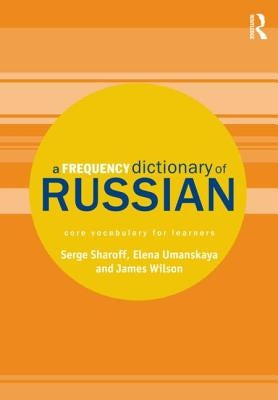
A Frequency Dictionary of Russian: core vocabulary for learners
A Frequency Dictionary of Russian: core vocabulary for learners
Couldn't load pickup availability
A Frequency Dictionary of Russian is an invaluable tool for all learners of Russian, providing a list of the 5,000 most frequently used words in the language and the 300 most frequent multiword constructions.
The dictionary is based on data from a 150-million-word internet corpus taken from more than 75,000 webpages and covering a range of text types from news and journalistic articles, research papers, administrative texts and fiction.
All entries in the rank frequency list feature the English equivalent, a sample sentence with English translation, a part of speech indication, indication of stress for polysyllabic words and information on inflection for irregular forms.
The dictionary also contains twenty-six thematically organised and frequency-ranked lists of words on a variety of topics, such as food and drink, travel, and sports and leisure.
A Frequency Dictionary of Russian enables students of all levels to get the most out of their study of vocabulary in an engaging and efficient way. It is also a rich resource for language teaching, research, curriculum design, and materials development.
A CD version is available to purchase separately. Designed for use by corpus and computational linguists it provides the full text in a format that researchers can process and turn into suitable lists for their own research purposes.
Author: Serge Sharoff, Elena Umanskaya, James Wilson
Publisher: Routledge
Published: 03/20/2013
Pages: 390
Binding Type: Paperback
Weight: 1.62lbs
Size: 9.75h x 6.90w x 0.89d
ISBN: 9780415521420
About the Author
Serge Sharoff is Senior Lecturer at the Centre for Translation Studies within the School of Modern Languages and Cultures, University of Leeds.
Elena Umanskaya is a freelance teacher of Russian as a foreign language.
James Wilson is Research Fellow at the Centre for Translation Studies within the School of Modern Languages and Cultures, University of Leeds.
Share