1
/
of
1
Oxford University Press, USA
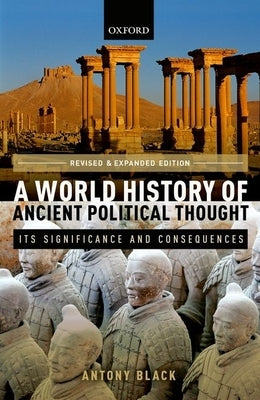
A World History of Ancient Political Thought: A World History of Ancient Political Thought: Its Significance and Consequences
A World History of Ancient Political Thought: A World History of Ancient Political Thought: Its Significance and Consequences
Regular price
€44,95 EUR
Regular price
Sale price
€44,95 EUR
Shipping calculated at checkout.
Quantity
Couldn't load pickup availability
This book examines the political thought of China, Greece, Israel, Rome, India, Iran, Egypt, Mesopotamia, and also early Christianity, from prehistory to c. 200 CE. Each of these had its own priorities, based on a religious and philosophical perspective. This led to different ideas about who
should govern, how to govern, and what government was for. In most cultures, sacred monarchy was the norm, but this ranged from absolute to conditional authority. 'The people' were recipients of royal (and divine) beneficence. Justice, the rule of law and meritocracy were generally regarded as fundamental. In Greece and Rome, democracy and liberty were
born, while in Israel the polity was based on covenant and the law. Confucius taught humaneness, Mozi and Christianity taught universal love; Kautilya and the Chinese 'Legalists' believed in realpolitik and an authoritarian state. The conflict between might and right was resolved in many different
ways. Chinese, Greek and Indian thinkers reflected on the origin and purposes of the state. Status and class were embedded in Indian and Chinese thought, the nation in Israelite thought. The Stoics and Cicero, on the other hand, saw humanity as a single unit. Political philosophy, using logic, evidence
and dialectic, was invented in China and Greece, statecraft in China and India, political science in Greece. Plato and Aristotle, followed by Polybius and Cicero, started 'western' political philosophy. This book covers political philosophy, religious ideology, constitutional theory, social ethics, official and popular political culture.
Author: Antony Black
Publisher: Oxford University Press, USA
Published: 12/27/2016
Pages: 304
Binding Type: Paperback
Weight: 2.45lbs
Size: 9.10h x 5.90w x 0.40d
ISBN: 9780198790686
should govern, how to govern, and what government was for. In most cultures, sacred monarchy was the norm, but this ranged from absolute to conditional authority. 'The people' were recipients of royal (and divine) beneficence. Justice, the rule of law and meritocracy were generally regarded as fundamental. In Greece and Rome, democracy and liberty were
born, while in Israel the polity was based on covenant and the law. Confucius taught humaneness, Mozi and Christianity taught universal love; Kautilya and the Chinese 'Legalists' believed in realpolitik and an authoritarian state. The conflict between might and right was resolved in many different
ways. Chinese, Greek and Indian thinkers reflected on the origin and purposes of the state. Status and class were embedded in Indian and Chinese thought, the nation in Israelite thought. The Stoics and Cicero, on the other hand, saw humanity as a single unit. Political philosophy, using logic, evidence
and dialectic, was invented in China and Greece, statecraft in China and India, political science in Greece. Plato and Aristotle, followed by Polybius and Cicero, started 'western' political philosophy. This book covers political philosophy, religious ideology, constitutional theory, social ethics, official and popular political culture.
Author: Antony Black
Publisher: Oxford University Press, USA
Published: 12/27/2016
Pages: 304
Binding Type: Paperback
Weight: 2.45lbs
Size: 9.10h x 5.90w x 0.40d
ISBN: 9780198790686
About the Author
Antony Black is Professor Emeritus in the History of Political Thought, School of Humanities, University of Dundee.
This title is not returnable
Share