1
/
of
1
University of Pittsburgh Press
Bandit Narratives in Latin America: From Villa to Chávez
Bandit Narratives in Latin America: From Villa to Chávez
Regular price
€33,95 EUR
Regular price
Sale price
€33,95 EUR
Shipping calculated at checkout.
Quantity
Couldn't load pickup availability
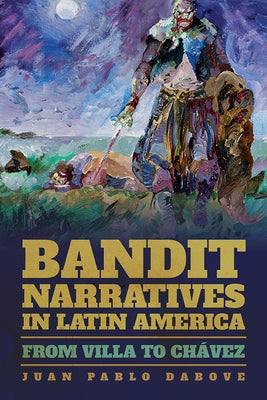
Bandits seem ubiquitous in Latin American culture. Even contemporary actors of violence are framed by narratives that harken back to old images of the rural bandit, either to legitimize or delegitimize violence, or to intervene in larger conflicts within or between nation-states.
However, the bandit escapes a straightforward definition, since the same label can apply to the leader of thousands of soldiers (as in the case of Villa) or to the humble highwayman eking out a meager living by waylaying travelers at machete point. Dabove presents the reader not with a definition of the bandit, but with a series of case studies showing how the bandit trope was used in fictional and non-fictional narratives by writers and political leaders, from the Mexican Revolution to the present. By examining cases from Argentina, Brazil, Mexico, Peru, and Venezuela, from Pancho Villa's autobiography to Hugo Chávez's appropriation of his "outlaw" grandfather, Dabove reveals how bandits function as a symbol to expose the dilemmas or aspirations of cultural and political practices, including literature as a social practice and as an ethical experience.
Author: Juan Pablo Dabove
Publisher: University of Pittsburgh Press
Published: 04/28/2017
Pages: 368
Binding Type: Paperback
Weight: 1.30lbs
Size: 8.90h x 6.00w x 1.10d
ISBN: 9780822964353
However, the bandit escapes a straightforward definition, since the same label can apply to the leader of thousands of soldiers (as in the case of Villa) or to the humble highwayman eking out a meager living by waylaying travelers at machete point. Dabove presents the reader not with a definition of the bandit, but with a series of case studies showing how the bandit trope was used in fictional and non-fictional narratives by writers and political leaders, from the Mexican Revolution to the present. By examining cases from Argentina, Brazil, Mexico, Peru, and Venezuela, from Pancho Villa's autobiography to Hugo Chávez's appropriation of his "outlaw" grandfather, Dabove reveals how bandits function as a symbol to expose the dilemmas or aspirations of cultural and political practices, including literature as a social practice and as an ethical experience.
Author: Juan Pablo Dabove
Publisher: University of Pittsburgh Press
Published: 04/28/2017
Pages: 368
Binding Type: Paperback
Weight: 1.30lbs
Size: 8.90h x 6.00w x 1.10d
ISBN: 9780822964353
About the Author
Juan Pablo Dabove is associate professor and associate chair of the department of Spanish and Portuguese at the University of Colorado at Boulder. He is the author of Nightmares of the Lettered City: Banditry and Literature in Latin America, 1816-1929.
Share