Indiana University Press
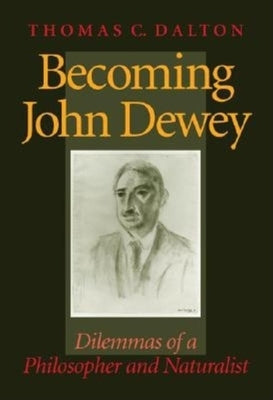
Becoming John Dewey: Dilemmas of a Philosopher and Naturalist
Becoming John Dewey: Dilemmas of a Philosopher and Naturalist
Couldn't load pickup availability
As one of America's public intellectuals, John Dewey was engaged in a lifelong struggle to understand the human mind and the nature of human inquiry. According to Thomas C. Dalton, the successful pursuit of this mission demanded that Dewey become more than just a philosopher; it compelled him to become thoroughly familiar with the theories and methods of physics, psychology, and neurosciences, as well as become engaged in educational and social reform. Tapping archival sources and Dewey's extensive correspondence, Dalton reveals that Dewey had close personal and intellectual ties to scientists and scholars who helped form the mature expression of his thought. Dewey's relationships with F. M. Alexander, Henri Matisse, Niels Bohr, Myrtle McGraw, and Lawrence K. Frank, among others, show how Dewey dispersed pragmatism throughout American thought and culture.
Author: Thomas Dalton
Publisher: Indiana University Press
Published: 09/11/2002
Pages: 400
Binding Type: Hardcover
Weight: 1.61lbs
Size: 9.72h x 6.40w x 1.15d
ISBN: 9780253340825
Review Citation(s):
Choice 01/01/2004 pg. 921
About the Author
Thomas C. Dalton is Senior Research Associate with the Office of the Dean of the College of Liberal Arts at California Polytechnic State University, San Luis Obispo. He is co-author (with V. W. Bergenn) of Early Experience and the Brain: An Historical and Interdisciplinary Synthesis, and co-editor (with Rand Evans) of Reflections in the Mirror of Psychology's Past: Understanding Prominence and the Dynamics of Intellectual Change and (with V. W. Bergenn) of Beyond Heredity and Environment: Myrtle McGraw and the Maturation Controversy. His scholarly research interests include historical studies of the developmental sciences, theoretical studies of consciousness, and the philosophy of mind.
Share