Duke University Press
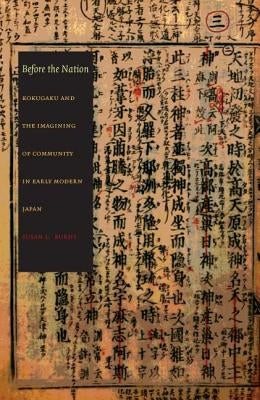
Before the Nation: Kokugaku and the Imagining of Community in Early Modern Japan
Before the Nation: Kokugaku and the Imagining of Community in Early Modern Japan
Couldn't load pickup availability
Central to Burns's analysis is Motoori Norinaga's Kojikiden, arguably the most important intellectual work of Japan's early modern period. Burns situates the Kojikiden as one in a series of attempts to analyze and interpret the mythohistories dating from the early eighth century, the Kojiki and Nihon shoki. Norinaga saw these texts as keys to an original, authentic, and idyllic Japan that existed before being tainted by "flawed" foreign influences, notably Confucianism and Buddhism. Hailed in the nineteenth century as the begetter of a new national consciousness, Norinaga's Kojikiden was later condemned by some as a source of Japan's twentieth-century descent into militarism, war, and defeat. Burns looks in depth at three kokugaku writers-Ueda Akinari, Fujitani Mitsue, and Tachibana Moribe-who contested Norinaga's interpretations and produced competing readings of the mythohistories that offered new theories of community as the basis for Japanese social and cultural identity. Though relegated to the footnotes by a later generation of scholars, these writers were quite influential in their day, and by recovering their arguments, Burns reveals kokugaku as a complex debate-involving history, language, and subjectivity-with repercussions extending well into the modern era.
Author: Susan L. Burns
Publisher: Duke University Press
Published: 12/02/2003
Pages: 296
Binding Type: Paperback
Weight: 0.93lbs
Size: 9.18h x 6.14w x 0.73d
ISBN: 9780822331728
Review Citation(s):
Choice 06/01/2004 pg. 1938
About the Author
Susan L. Burns is Associate Professor of History at the University of Chicago.
Share