Skip to product information
1 of 1

ECPR Press

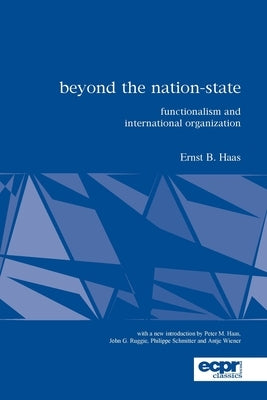
Beyond the Nation-State: Functionalism and International Organization

Beyond the Nation-State: Functionalism and International Organization

Regular price €100,95 EUR
Regular price Sale price €100,95 EUR
Sale Sold out
Shipping calculated at checkout.
Format
Quantity
Of all of the books produced by Ernst B Haas during his career, Beyond the Nation State contains the most complete and definitive statement of 'neo-functionalism': the theory of trans-national integration for which he is best known. Focusing on the International Labor Organization (ILO), Beyond the Nation-State was one of the first efforts to analyse systematically the dynamics and effects of a global international institution. This book is regarded as a classic in comparative politics, international relations and amongst students of European Integration and has enjoyed a renaissance with the end of the cold war, reinvigorated European integration, resumed interest in communitarian theorising, and efforts to theorise about forms of global governance which relied on a heightened role for international institutions and their associated policy communities. First published in 1964, this book was part of larger project described by others as 'neofunctionalism', 'regional integration', and 'soft constructivism', which animated Haas throughout his career. Beyond the Nation-State continues to provide valuable guidelines for describing and understanding contemporary IR, and is re-issued with a new introduction by Peter M. Haas, John G. Ruggie, Philippe Schmitter and Antje Wiener, placing this important work in a current context.

Author: Ernst Haas
Publisher: ECPR Press
Published: 11/01/2009
Pages: 584
Binding Type: Paperback
Weight: 2.05lbs
Size: 9.10h x 6.00w x 1.20d
ISBN: 9780955248870

About the Author
Ernst Bernard Haas was born in Frankfurt, Germany, in 1924. Haas and his family immigrated to the United States in 1938 where he attended the University of Chicago prior to working in the US Army Military Intelligence Service from 1943-1946. He received his PhD in public law and government in 1952 from Columbia University, where he had also received his BS and MA. Haas began his academic career in 1951 at UC Berkeley, where he remained until his death in 2003. He was director of the UC Berkeley Institute for International Studies from 1969-1973 and Robson Professor of Government. A leading authority on international relations theory, Haas was concerned with the concepts and process of international integration and is the founder of neofunctionalism as an approach to the study of integration. Haas was a fellow of the American Academy of Arts and Sciences, and he served as a consultant to many bodies in academia, publishing, government and international organizations, including the US Department of State, the United Nations and the Commission on Global Governance.

View full details