Steiner Books
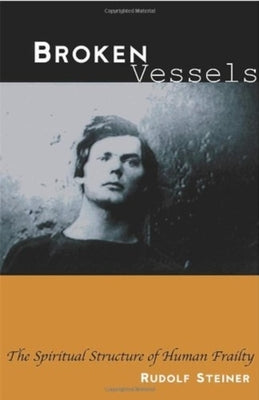
Broken Vessels: The Spiritual Structure of Human Frailty (Cw 318)
Broken Vessels: The Spiritual Structure of Human Frailty (Cw 318)
Couldn't load pickup availability
11 lectures in Dornach, September 8-19, 1924 (CW 318)
"Humans cannot be known by uncreative thoughts, because by their very nature human beings are creative. One must re-create if one wants knowledge. With today's passive thinking, one can understand only the periphery of the human being; one has to ignore the inner being." -- Rudolf SteinerToday we hear a great deal about holistic medicine--an approach to healing that integrates body, mind, and spirit. For Rudolf Steiner, healing is not possible unless it takes into account all the dimensions that make up a human being-both visible and invisible. Unless we begin to understand these dimensions of ourselves, real health will always be hard to attain.
To meet inner frailty with truly adequate concepts, Steiner describes specific inner structures of both healthy and unhealthy states that escape ordinary perception. Addressing topics ranging from sleepwalking to "hyperliteracy" to the visions of St. Teresa of Avila, he suggests how to approach the misalignments of nonstandard inner structures and other psychic difficulties with what he calls "pastoral medicine"--a truly holistic healing that can bring body and soul together and help them function in the most effective and powerful way.
Dr. Michael Lipson's foreword provides background for Steiner's lectures and brings them into the context of modern psychology.
This work is a translation of Das Zusammenwirken von Ärzten und Seelsorgern (CW 318). A previous edition was published as Pastoral Medicine: The Collegial Working of Doctors and Priests.
Author: Rudolf Steiner
Publisher: Steiner Books
Published: 02/01/2002
Pages: 176
Binding Type: Paperback
Weight: 0.52lbs
Size: 7.88h x 6.20w x 0.51d
ISBN: 9780880105033
About the Author
Steiner, Rudolf: - Rudolf Steiner (1861-1925) was born in the small village of Kraljevec, Austro-Hungarian Empire (now in Croatia), where he grew up. As a young man, he lived in Weimar and Berlin, where he became a well-published scientific, literary, and philosophical scholar, known especially for his work with Goethe's scientific writings. At the beginning of the twentieth century, he began to develop his early philosophical principles into an approach to systematic research into psychological and spiritual phenomena. Formally beginning his spiritual teaching career under the auspices of the Theosophical Society, Steiner came to use the term Anthroposophy (and spiritual science) for his philosophy, spiritual research, and findings. The influence of Steiner's multifaceted genius has led to innovative and holistic approaches in medicine, various therapies, philosophy, religious renewal, Waldorf education, education for special needs, threefold economics, biodynamic agriculture, Goethean science, architecture, and the arts of drama, speech, and eurythmy. In 1924, Rudolf Steiner founded the General Anthroposophical Society, which today has branches throughout the world. He died in Dornach, Switzerland.
Share