1
/
of
1
Cambridge University Press
Classical Solutions in Quantum Field Theory
Classical Solutions in Quantum Field Theory
Regular price
€94,95 EUR
Regular price
Sale price
€94,95 EUR
Shipping calculated at checkout.
Quantity
Couldn't load pickup availability
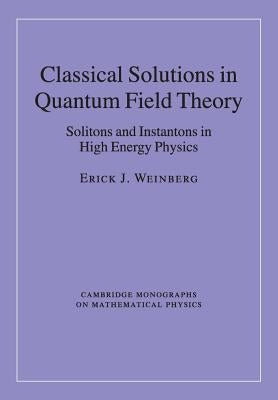
Classical solutions play an important role in quantum field theory, high energy physics and cosmology. Real-time soliton solutions give rise to particles, such as magnetic monopoles, and extended structures, such as domain walls and cosmic strings, that have implications for early universe cosmology. Imaginary-time Euclidean instantons are responsible for important nonperturbative effects, while Euclidean bounce solutions govern transitions between metastable states. Written for advanced graduate students and researchers in elementary particle physics, cosmology and related fields, this book brings the reader up to the level of current research in the field. The first half of the book discusses the most important classes of solitons: kinks, vortices and magnetic monopoles. The cosmological and observational constraints on these are covered, as are more formal aspects, including BPS solitons and their connection with supersymmetry. The second half is devoted to Euclidean solutions, with particular emphasis on Yang-Mills instantons and on bounce solutions.
Author: Erick J. Weinberg
Publisher: Cambridge University Press
Published: 05/02/2015
Pages: 342
Binding Type: Paperback
Weight: 1.20lbs
Size: 9.61h x 6.69w x 0.71d
ISBN: 9781107438057
Author: Erick J. Weinberg
Publisher: Cambridge University Press
Published: 05/02/2015
Pages: 342
Binding Type: Paperback
Weight: 1.20lbs
Size: 9.61h x 6.69w x 0.71d
ISBN: 9781107438057
About the Author
Weinberg, Erick J.: - Erick J. Weinberg is Professor of Physics in the Department of Physics, Columbia University. Since 1996 he has been Editor of Physical Review D. His research interests include the implications of solitons and instantons for high-energy physics, cosmology and black holes, as well as a variety of other topics in quantum field theory.
Share