Routledge
Crosslinguistic Perspectives on Argument Structure: Implications for Learnability
Crosslinguistic Perspectives on Argument Structure: Implications for Learnability
Couldn't load pickup availability
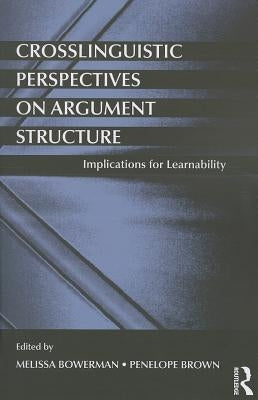
This book offers a unique interdisciplinary perspective on argument structure and its role in language acquisition. The volume is the outcome of an integrated research project and comprises chapters by both specialists in first language acquisition and field linguists working on a variety of lesser-known languages. Drawing on a broad range of crosslinguistic data, Crosslinguistic Perspectives on Argument Structure integrates important contemporary issues in linguistics and language acquisition.
Author: Melissa Bowerman
Publisher: Routledge
Published: 12/17/2013
Pages: 384
Binding Type: Paperback
Weight: 0.95lbs
Size: 9.30h x 6.10w x 0.60d
ISBN: 9780415721998
About the Author
Melissa Bowerman researched and published widely on topics in first language acquisition, especially lexical and morphosyntactic development. Recurrent themes in her work included the use of crosslinguistic methods to disentangle what is universal and possibly innate from what is variable and therefore learned, and the relationship between language development and conceptual development. She was particularly interested in the acquisition of argument structure alternations, variability across languages in the semantic classification of spatial relationships and everyday events, and how children master the specific semantic categories required by their language.
Penelope Brown's research and publications concern the relationship between culture and language and cognition. The central focus of her work is the study of language use in its sociocultural context. Her child language research uses crosslinguistic methodology to study the acquisition of morphology and semantics, language socialization, and social interaction of prelinguistic infants and caregivers. Her research on adult language ranges across the study of spatial language and cognition, crosscultural comparison of conversational structure and inference, the systematics of social interaction, the expression of social relations in speech, and principles of linguistic politeness.
Share