Diwan Press
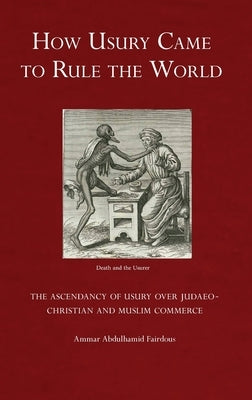
How Usury Came to Rule the World: The Ascendancy of Usury over Judaeo-Christian and Muslim Commerce
How Usury Came to Rule the World: The Ascendancy of Usury over Judaeo-Christian and Muslim Commerce
Couldn't load pickup availability
Author: Ammar Abdulhamid Fairdous
Publisher: Diwan Press
Published: 11/10/2023
Pages: 350
Binding Type: Hardcover
Weight: 1.57lbs
Size: 9.21h x 6.14w x 0.94d
ISBN: 9781914397066
About the Author
Fairdous, Ammar Abdulhamid: - Ammar Fairdous undertook various professional qualifications in Business and Management, including Islamic Finance while in the UK. He holds a Master's degree in International Commercial and Business Law from the University of East Anglia UK (UEA) and a Bachelor's degree in Islamic Law from Umm al-Qura University in Saudi Arabia. He completed a doctorate in International Commercial and Business Law at UEA with the thesis entitled, 'Evading the Taint of Usury: A Comparative Study of the Development of Lending and Credit Law within the Abrahamic Religions (Judaism, Christianity and Islam)', which is in essence this book. He has acted in a voluntary capacity as an Imam Khateeb at the reputable Ihsan Mosque in Norwich city centre.Ibrahim-Morrison, Uthman: - Uthman Ibrahim-Morrison was born to Jamaican parents in London and studied law as an undergraduate at UCL before going on to pursue postgraduate studies in applied linguistics at the University of Kent at Canterbury. He became Muslim in 1987 and had a leading hand in the establishment of the Brixton Mosque in South London in 1990. He became founder Chairman of the Blackstone Foundation educational trust in 1993 and presently lives in the city of Norwich as a prominent member of the well known Ihsan Mosque community, where he has been occupied with specialist teaching, writing and publishing since 1995.In his dual capacity as Chairman and Director of Education of the Blackstone Foundation he has played a key role in the development of innovative scholastic initiatives including the Norwich Academy for Muslims, the Wazania Academy for Girls, New Muslim Initiatives and most recently, the Muslim Faculty of Advanced Studies. He has been a visiting lecturer at the Dallas College in Cape Town and has regularly presented papers on Muslim schooling at educational conferences and colloquiums. He has also written extensively on the effect of Islam on the modern politics of African identity, as well as conducting related workshops
Share