Duke University Press
La Patria del Criollo: An Interpretation of Colonial Guatemala
La Patria del Criollo: An Interpretation of Colonial Guatemala
Couldn't load pickup availability
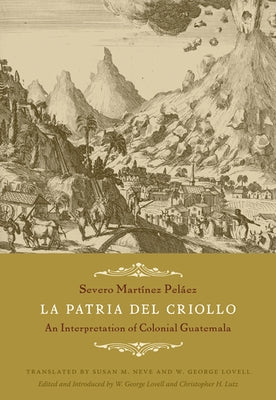
Mart nez Pel ez asserts that "the coffee dictatorships were the full and radical realization of criollo notions of the patria." This patria, or homeland, was one that criollos had wrested from Spaniards in the name of independence and taken control of based on claims of liberal reform. He contends that since labor is needed to make land productive, the exploitation of labor, particularly Indian labor, was a necessary complement to criollo appropriation. His depiction of colonial reality is bleak, and his portrayal of Spanish and criollo behavior toward Indians unrelenting in its emphasis on cruelty and oppression. Mart nez Pel ez felt that the grim past he documented surfaces each day in an equally grim present, and that confronting the past is a necessary step in any effort to improve Guatemala's woes. An extensive introduction situates La Patria del Criollo in historical context and relates it to contemporary issues and debates.
Author: Severo Martínez Peláez
Publisher: Duke University Press
Published: 05/15/2009
Pages: 384
Binding Type: Paperback
Weight: 1.15lbs
Size: 8.70h x 6.10w x 0.90d
ISBN: 9780822344155
Review Citation(s):
Chronicle of Higher Education 06/26/2009 pg. 16
Choice 04/01/2010
About the Author
Severo Martínez Peláez (1925-1998) is recognized as one of Central America's most distinguished men of letters. The Association of Guatemalan Journalists awarded him the Quetzal de Oro for La Patria del Criollo. Susan M. Neve, a translator specializing in Spanish language and literature, teaches at City University and the University of Westminster in London. W. George Lovell is Professor of Geography at Queen's University in Canada, and Visiting Lecturer in Latin American History at the Universidad Pablo de Olavide in Spain. Christopher H. Lutz is cofounder of Centro de Investigaciones Regionales de Mesoamérica in Antigua, Guatemala, and of the Maya Educational Foundation in Wellfleet, Massachusetts. He is Managing Director of Plumsock Mesoamerican Studies, also based in Wellfleet.
Share