1
/
of
1
Oxford University Press, USA
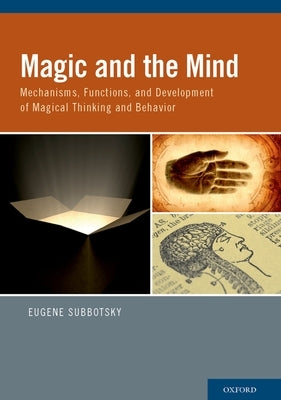
Magic and the Mind: Mechanisms, Functions, and Development of Magical Thinking and Behavior
Magic and the Mind: Mechanisms, Functions, and Development of Magical Thinking and Behavior
Regular price
€54,95 EUR
Regular price
Sale price
€54,95 EUR
Shipping calculated at checkout.
Quantity
Couldn't load pickup availability
Magical thinking and behavior have traditionally been viewed as immature, misleading alternatives to scientific thought that in children inevitably diminish with age. In adults, these inclinations have been labeled by psychologists largely as superstitions that feed on frustration,
uncertainty, and the unpredictable nature of certain human activities. In Magic and the Mind, Eugene Subbotsky provides an overview of the mechanisms and development of magical thinking and beliefs throughout the life span while arguing that the role of this type of thought in human development should be reconsidered. Rather than an impediment to scientific reasoning
or a byproduct of cognitive development, in children magical thinking is an important and necessary complement to these processes, enhancing creativity at problem-solving and reinforcing coping strategies, among other benefits. In adults, magical thinking and beliefs perform important functions both
for individuals (coping with unsolvable problems and stressful situations) and for society (enabling mass influence and promoting social harmony). Operating in realms not bound by physical causality, such as emotion, relationships, and suggestion, magical thinking is an ongoing, developing
psychological mechanism that, Subbotsky argues, is integral in the contexts of politics, commercial advertising, and psychotherapy, and undergirds our construction and understanding of meaning in both mental and physical worlds. Magic and the Mind represents a unique contribution to our
understanding of the importance of magical thinking, offering experimental evidence and conclusions never before collected in one source. It will be of interest to students and scholars of developmental psychology, as well as sociologists, anthropologists, and educators.
Author: Eugene Subbotsky
Publisher: Oxford University Press, USA
Published: 03/31/2010
Pages: 216
Binding Type: Hardcover
Weight: 1.05lbs
Size: 9.30h x 6.40w x 1.00d
ISBN: 9780195393873
uncertainty, and the unpredictable nature of certain human activities. In Magic and the Mind, Eugene Subbotsky provides an overview of the mechanisms and development of magical thinking and beliefs throughout the life span while arguing that the role of this type of thought in human development should be reconsidered. Rather than an impediment to scientific reasoning
or a byproduct of cognitive development, in children magical thinking is an important and necessary complement to these processes, enhancing creativity at problem-solving and reinforcing coping strategies, among other benefits. In adults, magical thinking and beliefs perform important functions both
for individuals (coping with unsolvable problems and stressful situations) and for society (enabling mass influence and promoting social harmony). Operating in realms not bound by physical causality, such as emotion, relationships, and suggestion, magical thinking is an ongoing, developing
psychological mechanism that, Subbotsky argues, is integral in the contexts of politics, commercial advertising, and psychotherapy, and undergirds our construction and understanding of meaning in both mental and physical worlds. Magic and the Mind represents a unique contribution to our
understanding of the importance of magical thinking, offering experimental evidence and conclusions never before collected in one source. It will be of interest to students and scholars of developmental psychology, as well as sociologists, anthropologists, and educators.
Author: Eugene Subbotsky
Publisher: Oxford University Press, USA
Published: 03/31/2010
Pages: 216
Binding Type: Hardcover
Weight: 1.05lbs
Size: 9.30h x 6.40w x 1.00d
ISBN: 9780195393873
About the Author
Psychology Department, Lancaster University (UK)
This title is not returnable
Share