1
/
of
1
Oxford University Press, USA
Mathematics and Reality
Mathematics and Reality
Regular price
€38,95 EUR
Regular price
Sale price
€38,95 EUR
Shipping calculated at checkout.
Quantity
Couldn't load pickup availability
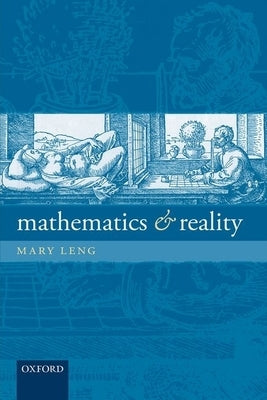
Mary Leng offers a defense of mathematical fictionalism, according to which we have no reason to believe that there are any mathematical objects. Perhaps the most pressing challenge to mathematical fictionalism is the indispensability argument for the truth of our mathematical theories (and
therefore for the existence of the mathematical objects posited by those theories). According to this argument, if we have reason to believe anything, we have reason to believe that the claims of our best empirical theories are (at least approximately) true. But since claims whose truth would
require the existence of mathematical objects are indispensable in formulating our best empirical theories, it follows that we have good reason to believe in the mathematical objects posited by those mathematical theories used in empirical science, and therefore to believe that the mathematical
theories utilized in empirical science are true. Previous responses to the indispensability argument have focussed on arguing that mathematical assumptions can be dispensed with in formulating our empirical theories. Leng, by contrast, offers an account of the role of mathematics in empirical
science according to which the successful use of mathematics in formulating our empirical theories need not rely on the truth of the mathematics utilized.
Author: Mary Leng
Publisher: Oxford University Press, USA
Published: 07/18/2013
Pages: 290
Binding Type: Paperback
Weight: 0.90lbs
Size: 9.21h x 6.14w x 0.61d
ISBN: 9780199674688
therefore for the existence of the mathematical objects posited by those theories). According to this argument, if we have reason to believe anything, we have reason to believe that the claims of our best empirical theories are (at least approximately) true. But since claims whose truth would
require the existence of mathematical objects are indispensable in formulating our best empirical theories, it follows that we have good reason to believe in the mathematical objects posited by those mathematical theories used in empirical science, and therefore to believe that the mathematical
theories utilized in empirical science are true. Previous responses to the indispensability argument have focussed on arguing that mathematical assumptions can be dispensed with in formulating our empirical theories. Leng, by contrast, offers an account of the role of mathematics in empirical
science according to which the successful use of mathematics in formulating our empirical theories need not rely on the truth of the mathematics utilized.
Author: Mary Leng
Publisher: Oxford University Press, USA
Published: 07/18/2013
Pages: 290
Binding Type: Paperback
Weight: 0.90lbs
Size: 9.21h x 6.14w x 0.61d
ISBN: 9780199674688
About the Author
Mary Leng is Lecturer in Philosophy at the University of Liverpool. She previously held a research fellowship at St John's College, Cambridge (2002-2006), and visiting fellowships at the University of California at Irvine (2001) and the Peter Wall Institute for Advanced Study at the University of British Columbia (2003). Her primary research interests are in the Philosophy of Mathematics and Logic, and the Philosophy of Science. She is the co-editor (with Alexander Paseau and Michael Potter) of Mathematical Knowledge (Oxford: OUP, 2007).
This title is not returnable
Share