1
/
of
1
Cambridge University Press
Performing Citizenship in Plato's Laws
Performing Citizenship in Plato's Laws
Regular price
€50,95 EUR
Regular price
Sale price
€50,95 EUR
Shipping calculated at checkout.
Quantity
Couldn't load pickup availability
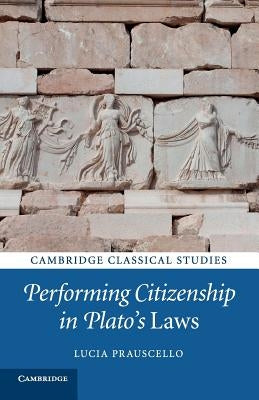
In the Laws, Plato theorizes citizenship as simultaneously a political, ethical, and aesthetic practice. His reflection on citizenship finds its roots in a descriptive psychology of human experience, with sentience and, above all, volition seen as the primary targets of a lifelong training in the values of citizenship. In the city of Magnesia described in the Laws er s for civic virtue is presented as a motivational resource not only within the reach of the 'ordinary' citizen, but also factored by default into its educational system. Supporting a vision of 'perfect citizenship' based on an internalized obedience to the laws, and persuading the entire polity to consent willingly to it, requires an ideology that must be rhetorically all-inclusive. In this city 'ordinary' citizenship itself will be troped as a performative action: Magnesia's choral performances become a fundamental channel for shaping, feeling and communicating a strong sense of civic identity and unity.
Author: Lucia Prauscello
Publisher: Cambridge University Press
Published: 10/19/2017
Pages: 282
Binding Type: Paperback
Weight: 0.73lbs
Size: 8.50h x 5.50w x 0.60d
ISBN: 9781107421165
Author: Lucia Prauscello
Publisher: Cambridge University Press
Published: 10/19/2017
Pages: 282
Binding Type: Paperback
Weight: 0.73lbs
Size: 8.50h x 5.50w x 0.60d
ISBN: 9781107421165
About the Author
Prauscello, Lucia: - Lucia Prauscello is University Senior Lecturer in Classics at the University of Cambridge and a Fellow of Trinity Hall. She has published on Greek philology, literature and music. Her monograph Singing Alexandria: Music between Practice and Textual Transmission was published in 2006.
Share