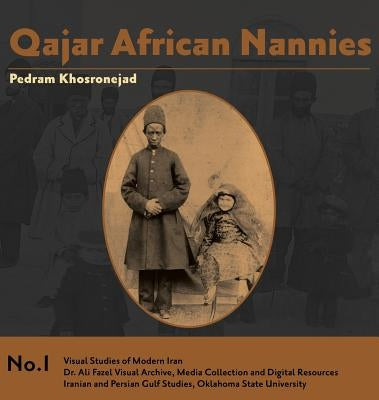
Visual Studies of Modern Iran
Qajar African Nannies: African Slaves and Aristocratic Babies
Qajar African Nannies: African Slaves and Aristocratic Babies
Couldn't load pickup availability
The study of race and ethnicity should be considered as an overlooked subject in the field of Iranian photography. One of the important themes in this regard which requires special attention is photography of enslaved people in Iran during the Qajar period. Students of the field have not shown any particular interest in photography of the enslaved in general, nor of African slaves in particular. Therefore, photography of Africans enslaved during the last decades of the Qajar period (1860s-1920s) should be considered as a new topic in the field of visual studies of modern Iran.
Qajar photographs in which the presence of African slaves (children, women and men) can be observed were mostly taken by Nasser al-Din Shah inside his harem, or in his own studio. The remainder of such photographs were taken by court photographers inside the court, during the king's travels, or on other occasions and locations but outside the court.
This book is the first of its kind to use photographs of the Qajar period to prove the level of ability of the medium to document and simultaneously pathologise the history, culture, story, and maybe struggle of African slave communities in Qajar Iran.
Pedram Khosronejad has amassed an incredible collection of major interest to historians of slavery, Africanists, scholars of photography, anthropologists, and others.
Uniquely and collectively these affecting portraits of stone-faced, sad-eyed men, women and children tell poignant stories of loss, violent separations, and brutal dislocation. Those are their stories and, as is too often forgotten, also those of their families, who lost them forever.
Looking at the vanished world Pedram Khosronejad rescued from oblivion and forces us to confront should also lead us to learn about the resilient contemporary Afro-Iranian community and its place in today's society.
Dr. Sylviane A. Diouf, Director of the Lapidus Center for the Historical Analysis of Transatlantic Slavery, Schomburg Centre, New York, USA.
Author: Pedram Khosronejad
Publisher: Visual Studies of Modern Iran
Published: 10/10/2017
Pages: 76
Binding Type: Hardcover
Weight: 0.82lbs
Size: 8.00h x 8.00w x 0.31d
ISBN: 9780999480106
About the Author
Khosronejad, Pedram: - Pedram Khosronejad is Farzaneh Family Chair and Associate Director for Iranian and Persian Gulf Studies Program (IPGS) at the Oklahoma State University and also associated member of Groupe Sociétés, Religions, Laicités, CNRS-Paris, France. He obtained his PhD at the École des Hautes Études en Sciences Sociales (EHESS) in Paris. His research interests include cultural and social anthropology, the anthropology of death and dying, visual anthropology, visual piety, devotional artefacts, and religious material culture, with a particular interest in Iran, Persianate societies and the Islamic world. He is author of Les Lions en Pierre Sculptée chez les Bakhtiari: Description et significations de sculptures zoomorphes dans une société tribale du sud-ouest de l'Iran, The Anthropology of Persianate Societies, Volume 2, Sean Kingston Publishing, U.K. He is also the editor of several publications: The Art and Material Culture of Iranian Shi'ism: Iconography and Religious Devotion in Shi'i Islam (I.B.Tauris); Saints and their Pilgrims in Iran and Neighboring Countries (SeanKingston); Iranian Sacred Defence Cinema: Religion, Martyrdom and National Identity (SeanKingston); Unburied Memories: The Politics of Bodies, and the Material Culture of Sacred Defense Martyrs in Iran (Routledge). He is also chief editor of the Anthropology of the Contemporary Middle East and Central Eurasia (ACME).
This title is not returnable
Share