Princeton University Press
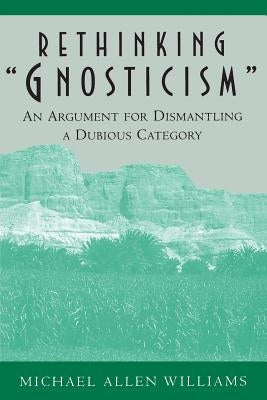
Rethinking Gnosticism: An Argument for Dismantling a Dubious Category
Rethinking Gnosticism: An Argument for Dismantling a Dubious Category
Couldn't load pickup availability
Most anyone interested in such topics as creation mythology, Jungian theory, or the idea of secret teachings in ancient Judaism and Christianity has found gnosticism compelling. Yet the term gnosticism, which often connotes a single rebellious movement against the prevailing religions of late antiquity, gives the false impression of a monolithic religious phenomenon. Here Michael Williams challenges the validity of the widely invoked category of ancient gnosticism and the ways it has been described. Presenting such famous writings and movements as the Apocryphon of John and Valentinian Christianity, Williams uncovers the similarities and differences among some major traditions widely categorized as gnostic. He provides an eloquent, systematic argument for a more accurate way to discuss these interpretive approaches.
The modern construct gnosticism is not justified by any ancient self-definition, and many of the most commonly cited religious features that supposedly define gnosticism phenomenologically turn out to be questionable. Exploring the sample sets of gnostic teachings, Williams refutes generalizations concerning asceticism and libertinism, attitudes toward the body and the created world, and alleged features of protest, parasitism, and elitism. He sketches a fresh model for understanding ancient innovations on more mainstream Judaism and Christianity, a model that is informed by modern research on dynamics in new religious movements and is freed from the false stereotypes from which the category gnosticism has been constructed.Author: Michael Allen Williams
Publisher: Princeton University Press
Published: 05/02/1999
Pages: 360
Binding Type: Paperback
Weight: 1.07lbs
Size: 9.24h x 6.10w x 0.89d
ISBN: 9780691005423
About the Author
Michael Allen Williams is Professor of Comparative Religion at the University of Washington, and is currently chair of the Department of Near East Languages and Civilization. He is also the author of The Immovable Race: A Gnostic Designation and the Theme of Stability in Late Antiquity and co-editor, with Collett Cox and Martin Jaffee, of Innovation in Religious Traditions: Essays in the Interpretation of Religious Change.
Share