1
/
of
1
University of Georgia Press
Silent Violence: Food, Famine, and Peasantry in Northern Nigeria
Silent Violence: Food, Famine, and Peasantry in Northern Nigeria
Regular price
€44,95 EUR
Regular price
Sale price
€44,95 EUR
Shipping calculated at checkout.
Quantity
Couldn't load pickup availability
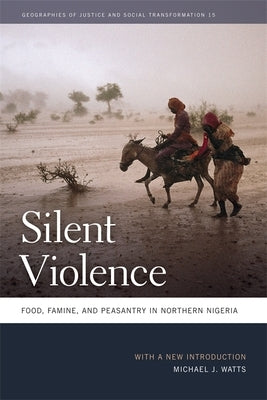
Why do famines occur and how have their effects changed through time? Why are those who produce food so often the casualties of famines? Looking at the food crisis that struck the West African Sahel during the 1970s, Michael J. Watts examines the relationships between famine, climate, and political economy.
Through a longue dur e history and a detailed village study Watts argues that famines are socially produced and that the market is as fickle and incalculable as the weather. Droughts are natural occurrences, matters of climatic change, but famines expose the inner workings of society, politics, and markets. His analysis moves from household and individual farming practices in the face of climatic variability to the incorporation of African peasants into the global circuits of capitalism in the colonial and postcolonial periods. Silent Violence powerfully combines a case study of food crises in Africa with an analysis of the way capitalism developed in northern Nigeria and how peasants struggle to maintain rural livelihoods. As the West African Sahel confronts another food crisis and continuing food insecurity for millions of peasants, Silent Violence speaks in a compelling way to contemporary agrarian dynamics, food provisioning systems, and the plight of the African poor.Author: Michael J. Watts
Publisher: University of Georgia Press
Published: 02/01/2013
Pages: 687
Binding Type: Paperback
Weight: 2.12lbs
Size: 9.00h x 6.00w x 2.01d
ISBN: 9780820344454
About the Author
MICHAEL J. WATTS is a professor and Class of 1963 Chair in the Geography and Development Studies Department at the University of California, Berkeley, where he has taught for thirty-five years. His many books include Global Political Ecology, Reworking Modernity, and The Curse of the Black Gold.
Share