Cambridge University Press
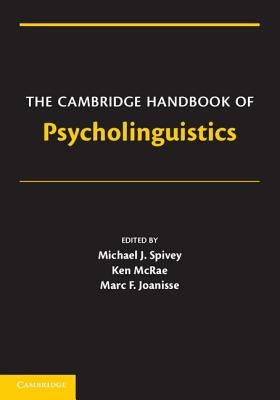
The Cambridge Handbook of Psycholinguistics
The Cambridge Handbook of Psycholinguistics
Couldn't load pickup availability
Author: Michael Spivey
Publisher: Cambridge University Press
Published: 04/10/2012
Pages: 760
Binding Type: Paperback
Weight: 2.90lbs
Size: 9.90h x 7.00w x 1.40d
ISBN: 9780521677929
Review Citation(s):
Choice 04/01/2013
About the Author
Spivey, Michael: - Michael J. Spivey was on the faculty of Cornell University for twelve years before moving to the Cognitive and Information Sciences unit at the University of California, Merced in 2008. His research uses dense-sampling methods (such as eye tracking and reach tracking) to explore the real-time interaction between language and vision. He has published in a variety of top-tier journals, including Science, Cognitive Science, Trends in Cognitive Sciences, Psychological Science and Proceedings of the National Academy of Sciences. Spivey is the recipient of Sigma Xi's William Procter Prize for Scientific Achievement and multiple teaching awards from Cornell University. The dynamical cognition framework that guides his research is described in his book The Continuity of Mind (2007).McRae, Ken: - Ken McRae has been at the University of Western Ontario since 1993, where he has been studying language and concepts. He has published articles regarding sentence processing and semantic memory from numerous perspectives, including modality-specific representations, the roles of statistical correlations and causal relations in object concepts, category-specific semantic deficits and the integration of meaning and structure in sentence comprehension. He has also published a number of computational models of these important human abilities. McRae has published in journals such as Cognition, the Journal of Memory and Language, the Journal of Experimental Psychology, Cognitive Science and Neuropsychologia.Joanisse, Marc: - Marc F. Joanisse has been at the University of Western Ontario since 2000, studying the cognitive and brain bases of spoken and written language. Work in his laboratory emphasizes the importance of studying multiple aspects of language ability, in a variety of populations, using a range of techniques. His research spans a range of topics encompassing speech perception, spoken word recognition and reading and grammar abilities in adults and children, using everything from traditional behavioral techniques to eye tracking, event-related potentials and fMRI. In addition, he has published articles in the field of connectionist modeling of language processing, aphasia following brain injury and language disorders in children. He has published in a wide range of journals, including the Proceedings of the National Academy of Sciences, the Journal of Cognitive Neuroscience, Cerebral Cortex, NeuroImage, the Journal of Memory and Language and the Journal of Experimental Psychology: Learning Memory and Cognition.
Share