Createspace Independent Publishing Platform
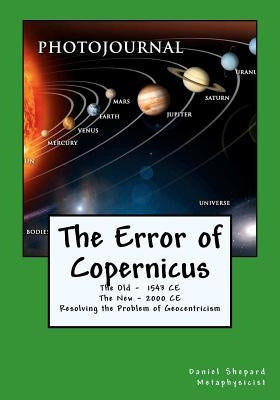
The Error of Copernicus: Resolving the Problem of Geocentricism
The Error of Copernicus: Resolving the Problem of Geocentricism
Couldn't load pickup availability
Author: Daniel J. Shepard
Publisher: Createspace Independent Publishing Platform
Published: 08/10/2011
Pages: 160
Binding Type: Paperback
Weight: 0.64lbs
Size: 10.00h x 7.01w x 0.34d
ISBN: 9781463762124
About the Author
Mathematics/Science Undergraduate degree - University of Michigan Master's degree in Physical Science - Eastern Michigan University 30 years teaching mathematics & science 20 years science and/or mathematics department chair I'm not sure if I became a philosophical thinker because I was a depressant or if I became a depressant because I was a philosophical thinker. Whichever the case, I am both. To make matters even stranger I am an optimistic depressant philosophical thinker. Actually it might be more accurate of me to state that I am an optimistic depressant philosophical thinking metaphysicist. But how did metaphysics enter the picture? During my early teens I began questioning what was 'out there beyond ...' Over time this thinking sequentially lead to 'beyond the stars', 'beyond the galaxy', 'beyond time and space' until I came to the end of the physical universe itself. Once I had reached this 'outer wall' of the physical universe. I could not help but mentally poke a hole in this wall. Having created a hole in the outer wall of the physical, I peered through the hole only to see nothing. At this point I was mesmerized with questions that forever haunted me: What is this nothingness on the 'outside' of the physical universe? What is the physical universe immersed within? What is out there? What are the characteristics of this existence outside the universe? What does this outside of the universe have to do with us, with myself, with God Itself? The questions became cruelly unrelenting and overpoweringly dominating of my very psyche. With time and the use of humanity's four perceptual tools (observation - science, universal teachings - religions, rational dialectics - philosophy and universal language - mathematics) the answers began to reveal themselves. The answers came not in terms of a bias on the part of one tool as opposed to another but in terms of all four tools agreeing with each other. The biggest hurdles to the work came in the form of cynicism, skepticism, closed minds and most of all in the form of the words, 'can't', 'its impossible to know', 'humankind is not intended to understand', 'prove it'. In all good conscience, it must be stated, 'We cannot prove anything beyond all doubt ...' Having stated the obvious, we can then move on to state: '... but we can 'prove beyond a reasonable doubt.' So it is a new model of reality emerged capable of leading our species into the new age of the third millennium.
This title is not returnable
Share