Cambridge University Press
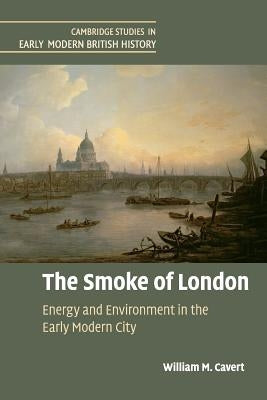
The Smoke of London: Energy and Environment in the Early Modern City
The Smoke of London: Energy and Environment in the Early Modern City
Couldn't load pickup availability
Author: William M. Cavert
Publisher: Cambridge University Press
Published: 10/19/2017
Pages: 294
Binding Type: Paperback
Weight: 0.88lbs
Size: 9.00h x 6.00w x 0.62d
ISBN: 9781107421318
About the Author
Cavert, William M.: - William M. Cavert is a historian of early modern Britain focusing on urban and environmental history, holding a Ph.D. from Northwestern University, Illinois. He has published 'The Environmental Policy of Charles I: Coal Smoke and the English Monarchy, 1624-1640' in the Journal of British Studies, as well as related studies in Global Environment and Urban History. His work has been supported by grants from The Mellon Foundation, the Huntington Library, the Horowitz Foundation for Social Policy, Northwestern University, the University of Cambridge, and the University of St Thomas, Minnesota, and by a fellowship at Clare College, Cambridge. His current research examines Britain during the Little Ice Age, focusing on cold winters, disasters, and relationships with animals.
Share