1
/
of
1
Cambridge University Press
Why Europe Grew Rich and Asia Did Not: Global Economic Divergence, 1600-1850
Why Europe Grew Rich and Asia Did Not: Global Economic Divergence, 1600-1850
Regular price
€140,95 EUR
Regular price
Sale price
€140,95 EUR
Shipping calculated at checkout.
Quantity
Couldn't load pickup availability
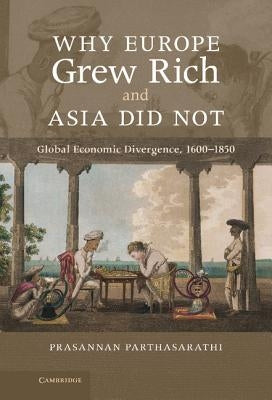
Why Europe Grew Rich and Asia Did Not provides a striking new answer to the classic question of why Europe industrialized from the late eighteenth century and Asia did not. Drawing significantly from the case of India, Prasannan Parthasarathi shows that in the seventeenth and eighteenth centuries, the advanced regions of Europe and Asia were more alike than different, both characterized by sophisticated and growing economies. Their subsequent divergence can be attributed to different competitive and ecological pressures that in turn produced varied state policies and economic outcomes. This account breaks with conventional views, which hold that divergence occurred because Europe possessed superior markets, rationality, science, or institutions. It offers instead a groundbreaking rereading of global economic development that ranges from India, Japan and China to Britain, France, and the Ottoman Empire and from the textile and coal industries to the roles of science, technology, and the state.
Author: Prasannan Parthasarathi
Publisher: Cambridge University Press
Published: 08/11/2011
Pages: 384
Binding Type: Hardcover
Weight: 1.49lbs
Size: 9.00h x 6.00w x 0.90d
ISBN: 9781107000308
Review Citation(s):
Choice 04/01/2012
Author: Prasannan Parthasarathi
Publisher: Cambridge University Press
Published: 08/11/2011
Pages: 384
Binding Type: Hardcover
Weight: 1.49lbs
Size: 9.00h x 6.00w x 0.90d
ISBN: 9781107000308
Review Citation(s):
Choice 04/01/2012
About the Author
Parthasarathi, Prasannan: - Prasannan Parthasarathi is Associate Professor in the Department of History at Boston College. His previous publications include The Transition to a Colonial Economy: Weavers, Merchants and Kings in South India, 1720-1800 (Cambridge University Press, 2001) and The Spinning World: A Global History of Cotton Textiles, 1200-1850 (co-edited with Giorgio Riello, 2009).
Share