Princeton University Press
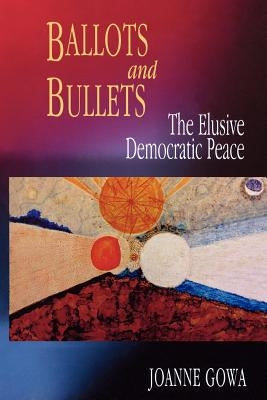
Ballots and Bullets: The Elusive Democratic Peace
Ballots and Bullets: The Elusive Democratic Peace
Couldn't load pickup availability
There is a widespread belief, among both political scientists and government policymakers, that democracies don't fight each other. Here Joanne Gowa challenges that belief. In a thorough, systematic critique, she shows that, while democracies were less likely than other states to engage each other in armed conflicts between 1945 and 1980, they were just as likely to do so as were other states before 1914. Thus, no reason exists to believe that a democratic peace will survive the end of the Cold War. Since U.S. foreign policy is currently directed toward promoting democracy abroad, Gowa's findings are especially timely and worrisome.
Those who assert that a democratic peace exists typically examine the 1815-1980 period as a whole. In doing so, they conflate two very different historical periods: the pre-World War I and post-World War II years. Examining these periods separately, Gowa shows that a democratic peace prevailed only during the later period. Given the collapse of the Cold War world, her research calls into question both the conclusions of previous researchers and the wisdom of present U.S. foreign policy initiatives. By re-examining the arguments and data that have been used to support beliefs about a democratic peace, Joanne Gowa has produced a thought-provoking book that is sure to be controversial.Author: Joanne Gowa
Publisher: Princeton University Press
Published: 07/30/2000
Pages: 144
Binding Type: Paperback
Weight: 0.50lbs
Size: 9.21h x 6.09w x 0.48d
ISBN: 9780691070223
About the Author
Joanne Gowa is Professor of World Politics of Peace and War at Princeton University. She is the author of Allies, Adversaries, and International Trade (Princeton) and Closing the Gold Window: Domestic Politics and the End of Bretton Woods.
Share