1
/
of
1
Oxford University Press
Biological Small Angle Scattering: Theory and Practice
Biological Small Angle Scattering: Theory and Practice
Regular price
$241.98 USD
Regular price
Sale price
$241.98 USD
Shipping calculated at checkout.
Quantity
Couldn't load pickup availability
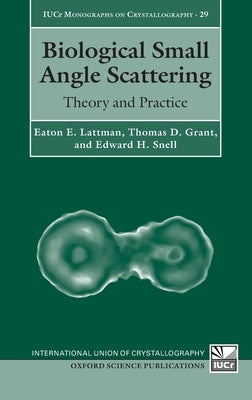
Small angle solution scattering (SAS) is increasingly being applied to biological problems. It is a complementary technique that, when applied in appropriate circumstances with carefully structured questions, can provide unique information not available from other techniques. While small angle solution scattering has been around for some time, a confluence of recent developments has dramatically enhanced its power. Intense third generation X-ray sources, low noise detectors, development of new algorithms and the computational power to take advantage of these have all matured, and use of free-electron x-ray laser sources is on the horizon. Whole new classes of experiments and analyses have been created as a result. These include the generation of molecular envelopes, the ability to do time-resolved studies, and the ability to account for structural changes using modelling based on the SAS data. The technical improvements have also reduced the amount of time and material needed to carry out an experiment. Beamtime at synchrotron sources is in demand, workshops on the subject are popular and researchers adopting the technique as part of their repertoire are growing. With these in mind, this book was written to guide structural biologists who may wish to adopt the technique, understand its strengths and weaknesses or just have a general interest in its potential.
Author: Eaton E. Lattman,Thomas D. Grant,Edward H. Snell
Publisher: Oxford University Press
Published: 09/19/2018
Pages: 284
Binding Type: Hardcover
Weight: 1.45lbs
Size: 9.30h x 6.40w x 0.80d
ISBN: 9780199670871
Thomas Grant received a B.S. degree from the University at Buffalo in Mathematical Physics and a PhD from the University at Buffalo in Structural Biology. After a post-doc at the Hauptman-Woodward Institute, he became a Staff Scientist as part of the NSF Science and Technology Center known as BioXFEL through the University at Buffalo. Edward Snell is President and Chief Executive Officer at the Hauptman-Woodward Medical Research Institute in Buffalo, NY, and Bioinnovations Professor at the University of Buffalo, SUNY.
Author: Eaton E. Lattman,Thomas D. Grant,Edward H. Snell
Publisher: Oxford University Press
Published: 09/19/2018
Pages: 284
Binding Type: Hardcover
Weight: 1.45lbs
Size: 9.30h x 6.40w x 0.80d
ISBN: 9780199670871
About the Author
Eaton E. Lattman, Professor of Structural Biology, School of Medicine and Biomedical Sciences, University at Buffalo, SUNY, Thomas D. Grant, Staff Scientist, BioXFEL Science and Technology Center, School of Medicine and Biomedical Sciences, University at Buffalo, SUNY, Edward H. Snell, President and Chief Executive Officer, Hauptman-Woodward Medical Research Institute
Thomas Grant received a B.S. degree from the University at Buffalo in Mathematical Physics and a PhD from the University at Buffalo in Structural Biology. After a post-doc at the Hauptman-Woodward Institute, he became a Staff Scientist as part of the NSF Science and Technology Center known as BioXFEL through the University at Buffalo. Edward Snell is President and Chief Executive Officer at the Hauptman-Woodward Medical Research Institute in Buffalo, NY, and Bioinnovations Professor at the University of Buffalo, SUNY.
Share