Stanford University Press
Coevolution: Genes, Culture, and Human Diversity
Coevolution: Genes, Culture, and Human Diversity
Couldn't load pickup availability
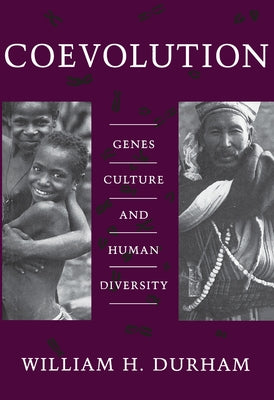
The author suggests that a process of cultural selection, or preservation by preference, driven chiefly by choice or imposition depending on the circumstances, has been the main but not exclusive force of cultural change. He shows that this process gives rise to five major patterns or "modes" in which cultural change is at odds with genetic change. Each of the five modes is discussed in some detail and its existence confirmed through one or more case studies chosen for their heuristic value, the robustness of their data, and their broader implications. But "Coevolution" predicts not simply the existence of the five modes of gene-culture relations; it also predicts their relative importance in the ongoing dynamics of cultural change in particular cases. The case studies themselves are lucid and innovative reexaminations of an array of oft-pondered anthropological topics--plural marriage, sickle-cell anemia, basic color terms, adult lactose absorption, incest taboos, headhunting, and cannibalism.
In a general case, the author's goal is to demonstrate that an evolutionary analysis of both genes and culture has much to contribute to our understanding of human diversity, particularly behavioral diversity, and thus to the resolution of age-old questions about nature and nurture, genes and culture.
Author: William H. Durham
Publisher: Stanford University Press
Published: 08/01/1992
Pages: 656
Binding Type: Paperback
Weight: 2.15lbs
Size: 8.96h x 6.12w x 1.59d
ISBN: 9780804721561
Review Citation(s):
Ingram Advance 07/01/1999 pg. 98
Share