Cambridge University Press
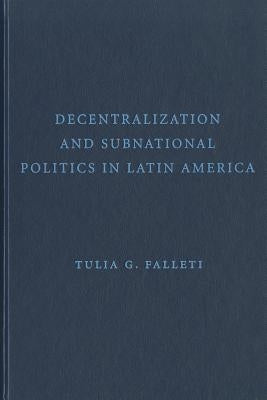
Decentralization and Subnational Politics in Latin America
Decentralization and Subnational Politics in Latin America
Couldn't load pickup availability
Author: Tulia G. Falleti
Publisher: Cambridge University Press
Published: 04/12/2010
Pages: 312
Binding Type: Hardcover
Weight: 1.20lbs
Size: 9.10h x 6.20w x 0.90d
ISBN: 9780521516792
About the Author
Falleti, Tulia G.: - Tulia G. Falleti is an Assistant Professor of Political Science at the University of Pennsylvania. Her work on decentralization, federalism, and research methodology has appeared in the American Political Science Review, Comparative Political Studies, Publius, Qualitative Sociology, Critique Internationale (France), Desarrollo Económico (Argentina), Política y Gobierno (Mexico), and Sociologias (Brazil), as well as in edited volumes published in the United States, Argentina, and Brazil. She has received awards and fellowships from the Social Science Research Council, the United States Institute of Peace, the Ford Foundation in conjunction with the Latin American Studies Association, and the Ministry of Science, Technology, and Productive Innovation of Argentina. In 2006, she earned the Gregory Luebbert Award from the American Political Science Association for the best article in comparative politics for her article 'A Sequential Theory of Decentralization: Latin American Cases in Comparative Perspective.'
Share