1
/
of
1
Oxford University Press, USA
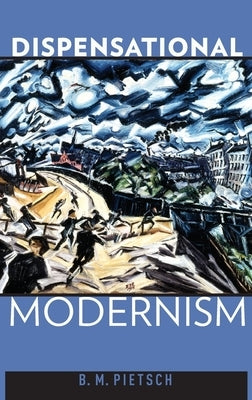
Dispensational Modernism
Dispensational Modernism
Regular price
$102.00 USD
Regular price
Sale price
$102.00 USD
Shipping calculated at checkout.
Quantity
Couldn't load pickup availability
Dispensationalism emerged in the twentieth century as a hugely influential force in American religion and soon became one of America's most significant religious exports. By the close of the century it had developed into a global religious phenomenon claiming millions of adherents. As the most
common form of contemporary prophecy belief, dispensationalism has played a major role in transforming religion, politics, and pop culture in the U.S. and throughout the world. Despite its importance and continuing appeal, scholars often reduce dispensationalism to an anti-modern, apocalyptic, and
literalist branch of Protestant fundamentalism. In Dispensational Modernism, B. M. Pietsch argues that, on the contrary, the allure of dispensational thinking can best be understood through the lens of technological modernism. Pietsch shows that between 1870 and 1920 dispensationalism grew out of the popular fascination with applying engineering methods -- such as quantification and classification -- to the interpretation of texts and time. At the heart of this new network of texts, scholars, institutions, and practices
was the lightning-rod Bible teacher C. I. Scofield, whose best-selling Scofield Reference Bible became the canonical formulation of dispensational thought. The first book to contextualize dispensationalism in this provocative way, Dispensational Modernism shows how mainstream Protestant clergy of
this time developed new scientific methods for interpreting the Bible, and thus new grounds for confidence in religious understandings of time itself.
Author: B. M. Pietsch
Publisher: Oxford University Press, USA
Published: 07/06/2015
Pages: 272
Binding Type: Hardcover
Weight: 1.00lbs
Size: 9.30h x 6.10w x 1.00d
ISBN: 9780190244088
common form of contemporary prophecy belief, dispensationalism has played a major role in transforming religion, politics, and pop culture in the U.S. and throughout the world. Despite its importance and continuing appeal, scholars often reduce dispensationalism to an anti-modern, apocalyptic, and
literalist branch of Protestant fundamentalism. In Dispensational Modernism, B. M. Pietsch argues that, on the contrary, the allure of dispensational thinking can best be understood through the lens of technological modernism. Pietsch shows that between 1870 and 1920 dispensationalism grew out of the popular fascination with applying engineering methods -- such as quantification and classification -- to the interpretation of texts and time. At the heart of this new network of texts, scholars, institutions, and practices
was the lightning-rod Bible teacher C. I. Scofield, whose best-selling Scofield Reference Bible became the canonical formulation of dispensational thought. The first book to contextualize dispensationalism in this provocative way, Dispensational Modernism shows how mainstream Protestant clergy of
this time developed new scientific methods for interpreting the Bible, and thus new grounds for confidence in religious understandings of time itself.
Author: B. M. Pietsch
Publisher: Oxford University Press, USA
Published: 07/06/2015
Pages: 272
Binding Type: Hardcover
Weight: 1.00lbs
Size: 9.30h x 6.10w x 1.00d
ISBN: 9780190244088
About the Author
B. M. Pietsch is Assistant Professor of Religious Studies at Nazarbayev University, in Astana, Kazakhstan.
Share