1
/
of
1
Oxford University Press, USA
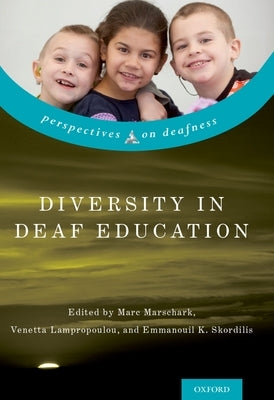
Diversity in Deaf Education
Diversity in Deaf Education
Regular price
$130.00 USD
Regular price
Sale price
$130.00 USD
Shipping calculated at checkout.
Quantity
Couldn't load pickup availability
Deaf children are not hearing children who can't hear. Beyond any specific effects of hearing loss, as a group they are far more diverse than hearing peers. Lack of full access to language, incidental learning, and social interactions as well as the possibility of secondary disabilities means
that deaf learners face a variety of challenges in academic domains. Technological innovations such as digital hearing aids and cochlear implants have improved hearing and the possibility of spoken language for many deaf learners, but parents, teachers, and other professionals are just now coming to
recognize that there are cognitive, experiential, and social-emotional differences between deaf and hearing students likely to affect academic outcomes. Sign languages and schools and programs for deaf learners thus remain an important part of the continuum of services needed for this diverse
population. Understanding such diversity and determining ways in which to accommodate them must become a top priority in educating deaf learners. Through the participation of an international, interdisciplinary set of scholars, Diversity in Deaf Education takes a broad view of learning and academic progress, considering the whole child in the context of the families, languages, educational settings in which they are immersed. In adopting
this perspective, the complexities and commonalities in the social, emotional, cognitive, and linguistic mosaic of which the deaf child is a part, are captured. It is only through such a holistic consideration of diverse children developing within diverse settings that we can understand their
academic potentials.
Author: Marc Marschark
Publisher: Oxford University Press, USA
Published: 06/28/2016
Pages: 568
Binding Type: Hardcover
Weight: 1.90lbs
Size: 9.40h x 6.40w x 1.70d
ISBN: 9780190493073
that deaf learners face a variety of challenges in academic domains. Technological innovations such as digital hearing aids and cochlear implants have improved hearing and the possibility of spoken language for many deaf learners, but parents, teachers, and other professionals are just now coming to
recognize that there are cognitive, experiential, and social-emotional differences between deaf and hearing students likely to affect academic outcomes. Sign languages and schools and programs for deaf learners thus remain an important part of the continuum of services needed for this diverse
population. Understanding such diversity and determining ways in which to accommodate them must become a top priority in educating deaf learners. Through the participation of an international, interdisciplinary set of scholars, Diversity in Deaf Education takes a broad view of learning and academic progress, considering the whole child in the context of the families, languages, educational settings in which they are immersed. In adopting
this perspective, the complexities and commonalities in the social, emotional, cognitive, and linguistic mosaic of which the deaf child is a part, are captured. It is only through such a holistic consideration of diverse children developing within diverse settings that we can understand their
academic potentials.
Author: Marc Marschark
Publisher: Oxford University Press, USA
Published: 06/28/2016
Pages: 568
Binding Type: Hardcover
Weight: 1.90lbs
Size: 9.40h x 6.40w x 1.70d
ISBN: 9780190493073
About the Author
Marc Marschark is a Professor at the National Technical Institute for the Deaf, a college of Rochester Institute of Technology, where he directs the Center for Education Research Partnerships. His primary interest is in relations among language, learning, and cognition; current research focuses on such relations among deaf children and adults in formal and informal educational settings. He was founding editor of the Journal of Deaf Studies and Deaf Education.
Share