1
/
of
1
Oxford University Press, USA
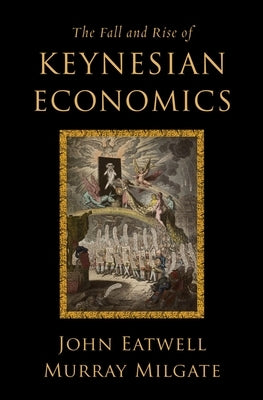
Fall and Rise of Keynesian Economics
Fall and Rise of Keynesian Economics
Regular price
$93.00 USD
Regular price
Sale price
$93.00 USD
Shipping calculated at checkout.
Quantity
Couldn't load pickup availability
During the 1970s, monetarism and the new classical macroeconomics ushered in an era of neoliberal economic policymaking. Keynesian economics was pushed aside. It was almost forgotten that when Keynesian thinking had dominated economic policymaking in the middle decades of the twentieth
century, it had coincided with postwar economic reconstruction in both Europe and Japan, and the unprecedented prosperity and stable growth of the 1950s and 1960s. The global financial crisis of 2007-2009 and the recession that followed changed all that. Influential voices in both academic economics
and amongst policy-makers and commentators began to remind us how useful Keynesian ways of thinking could be, especially in coming to terms with our current economic predicaments. When politicians across the globe were confronted with economic crisis, they introduced pragmatic and workable measures
that bore all the hallmarks of Keynesianism. This book is about the fall and rise of Keynesian economics. Eatwell and Milgate range widely across the landscape that defines their subject matter. They consider how powerful Keynesian ideas can be when applied to past and present economic problems. They show how helpful these ideas are in explaining why we came to find ourselves in the disorder we are in.
They examine where and how the analytical and methodological foundations of conventional macroeconomic wisdom went wrong. They set out a blueprint for an alternative that provides a clearer, more consistent, and more applicable approach to understanding how markets work. They also highlight the
interpretive shortcomings that have come to characterize Keynes scholarship itself. They do all of this within the context of a provocative reconsideration of some of the most pressing economic problems that confront financial markets and the global economy today. They conclude that Keynesian ideas
are not just for crises, but for constructive economic policy making at all times.
Author: John Eatwell, Murray Milgate
Publisher: Oxford University Press, USA
Published: 04/18/2011
Pages: 448
Binding Type: Hardcover
Weight: 1.78lbs
Size: 9.39h x 6.36w x 1.11d
ISBN: 9780199777693
century, it had coincided with postwar economic reconstruction in both Europe and Japan, and the unprecedented prosperity and stable growth of the 1950s and 1960s. The global financial crisis of 2007-2009 and the recession that followed changed all that. Influential voices in both academic economics
and amongst policy-makers and commentators began to remind us how useful Keynesian ways of thinking could be, especially in coming to terms with our current economic predicaments. When politicians across the globe were confronted with economic crisis, they introduced pragmatic and workable measures
that bore all the hallmarks of Keynesianism. This book is about the fall and rise of Keynesian economics. Eatwell and Milgate range widely across the landscape that defines their subject matter. They consider how powerful Keynesian ideas can be when applied to past and present economic problems. They show how helpful these ideas are in explaining why we came to find ourselves in the disorder we are in.
They examine where and how the analytical and methodological foundations of conventional macroeconomic wisdom went wrong. They set out a blueprint for an alternative that provides a clearer, more consistent, and more applicable approach to understanding how markets work. They also highlight the
interpretive shortcomings that have come to characterize Keynes scholarship itself. They do all of this within the context of a provocative reconsideration of some of the most pressing economic problems that confront financial markets and the global economy today. They conclude that Keynesian ideas
are not just for crises, but for constructive economic policy making at all times.
Author: John Eatwell, Murray Milgate
Publisher: Oxford University Press, USA
Published: 04/18/2011
Pages: 448
Binding Type: Hardcover
Weight: 1.78lbs
Size: 9.39h x 6.36w x 1.11d
ISBN: 9780199777693
About the Author
John Eatwell has taught economics at Cambridge since 1970, and became President of Queens' College, Cambridge, in 1997. From 1980 to 1996 he was also a Professor in the Graduate Faculty of the New School for Social Research, New York. He was co-editor of the New Palgrave Dictionary of Economics. Recent books include Global Finance at Risk: The Case for International Regulation, Hard Budgets and Soft States: Social Policy Choices in Central and Eastern Europe, and Global Governance of Financial Systems: The Legal and Economic Regulation of Systemic Risk. He is a member of the House of Lords.
This title is not returnable
Share