1
/
of
1
Oxford University Press, USA
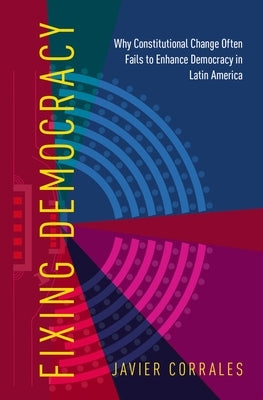
Fixing Democracy: Why Constitutional Change Often Fails to Enhance Democracy in Latin America
Fixing Democracy: Why Constitutional Change Often Fails to Enhance Democracy in Latin America
Regular price
$40.95 USD
Regular price
Sale price
$40.95 USD
Shipping calculated at checkout.
Quantity
Couldn't load pickup availability
The study of institutions, a core concept in comparative politics, has produced many rich and influential theories on the economic and political effects of institutions, yet it has been less successful at theorizing their origins. In Fixing Democracy, Javier Corrales develops a theory of
institutional origins that concentrates on constitutions and levels of power within them. He reviews numerous Latin American constituent assemblies and constitutional amendments to explore why some democracies expand rather than restrict presidential powers and why this heightened presidentialism
discourages democracy. His signal theoretical contribution is his elaboration on power asymmetries. Corrales determines that conditions of reduced power asymmetry make constituent assemblies more likely to curtail presidential powers, while weaker opposition and heightened power asymmetry is an
indicator that presidential powers will expand. The bargain-based theory that he uses focuses on power distribution and provides a more accurate variable in predicting actual constitutional outcomes than other approaches based on functionalism or ideology. While the empirical focus is Latin America,
Fixing Democracy contributes a broadly applicable theory to the scholarship both institutions and democracy.
Author: Javier Corrales
Publisher: Oxford University Press, USA
Published: 06/26/2018
Pages: 288
Binding Type: Paperback
Weight: 0.88lbs
Size: 9.10h x 6.10w x 0.80d
ISBN: 9780190868901
Review Citation(s):
Choice 02/01/2019
institutional origins that concentrates on constitutions and levels of power within them. He reviews numerous Latin American constituent assemblies and constitutional amendments to explore why some democracies expand rather than restrict presidential powers and why this heightened presidentialism
discourages democracy. His signal theoretical contribution is his elaboration on power asymmetries. Corrales determines that conditions of reduced power asymmetry make constituent assemblies more likely to curtail presidential powers, while weaker opposition and heightened power asymmetry is an
indicator that presidential powers will expand. The bargain-based theory that he uses focuses on power distribution and provides a more accurate variable in predicting actual constitutional outcomes than other approaches based on functionalism or ideology. While the empirical focus is Latin America,
Fixing Democracy contributes a broadly applicable theory to the scholarship both institutions and democracy.
Author: Javier Corrales
Publisher: Oxford University Press, USA
Published: 06/26/2018
Pages: 288
Binding Type: Paperback
Weight: 0.88lbs
Size: 9.10h x 6.10w x 0.80d
ISBN: 9780190868901
Review Citation(s):
Choice 02/01/2019
About the Author
Javier Corrales is Dwight W. Morrow 1895 Professor of Political Science at Amherst College and obtained his PhD in Government from Harvard University in 1996. He specializes in comparative politics and international relations of Latin America. He has written extensively on economic reforms,
democratization, presidential powers, term limits, education policy and international relations. He has been a Fulbright scholar in Bogotá, Colombia, and Caracas, Venezuela. He is on the editorial board of Latin American Politics and Society and Americas Quarterly, and the European Review of Latin
American and Caribbean Studies.
This title is not returnable
Share