1
/
of
1
Oxford University Press, USA
Guide to Treatments That Work (Revised)
Guide to Treatments That Work (Revised)
Regular price
$340.57 USD
Regular price
Sale price
$340.57 USD
Shipping calculated at checkout.
Quantity
Couldn't load pickup availability
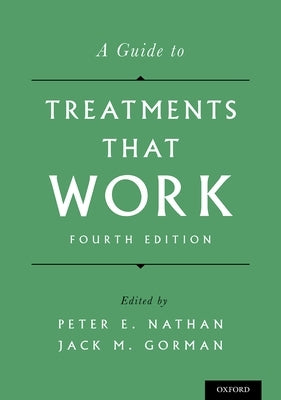
Like its predecessors, this fourth edition of A Guide to Treatments That Work offers detailed chapters that review the latest research on pharmacological and psychosocial treatments that work for the full range of psychiatric and psychological disorders, written in most instances by clinical
psychologists and psychiatrists who have been major contributors to that literature. Similarly, the standards by which the authors were asked to evaluate the methodological rigor of the research on treatments have also remained the same. Each chapter in A Guide to Treatments That Work follows the same general outline: a review of diagnostic cues to the disorder, a discussion of changes in the nomenclatures from DSM-IV to DSM-5, and then a systematic review of research, most of which has been reported within the last few years, that
represents the evidence base for the treatments reviewed. In all, 26 of the volume's 28 chapters review the evidence base for 17 major syndromes. Featuring this coverage is a Summary of Treatments that Work, an extended matrix offering a ready reference by syndrome of the conclusions reached by the
chapter authors on treatments that work reviewed in their chapters. New to this edition are two chapters at the beginning of the book. Chapter 1 details two perplexing issues raised by critics of DSM-5: the unrealized potential of neuroscience biomarkers to yield more accurate and reliable diagnoses
and the lingering problem of conflicts of interest in pharmaceutical research. Chapter 2 contrasts Native American and western ways of identifying effective treatments for mental and physical disorders, concluding that evidence-informed culture-based interventions sometimes constitute best
practices in Native communities. Two chapters detailing pharmacological treatments for pediatric bipolar disorder (Chapter 9) and pediatric depressive disorder (Chapter 12) have also been added. More than three quarters of the chapters are written by colleagues who also contributed to most or all of
the previous editions. Hence, this new edition provides up-to-date information on the quality of research on treatment efficacy and effectiveness provided by individuals who know the research best.
Author: Peter E. Nathan
Publisher: Oxford University Press, USA
Published: 07/24/2015
Pages: 988
Binding Type: Hardcover
Weight: 4.15lbs
Size: 10.00h x 7.50w x 2.20d
ISBN: 9780199342211
psychologists and psychiatrists who have been major contributors to that literature. Similarly, the standards by which the authors were asked to evaluate the methodological rigor of the research on treatments have also remained the same. Each chapter in A Guide to Treatments That Work follows the same general outline: a review of diagnostic cues to the disorder, a discussion of changes in the nomenclatures from DSM-IV to DSM-5, and then a systematic review of research, most of which has been reported within the last few years, that
represents the evidence base for the treatments reviewed. In all, 26 of the volume's 28 chapters review the evidence base for 17 major syndromes. Featuring this coverage is a Summary of Treatments that Work, an extended matrix offering a ready reference by syndrome of the conclusions reached by the
chapter authors on treatments that work reviewed in their chapters. New to this edition are two chapters at the beginning of the book. Chapter 1 details two perplexing issues raised by critics of DSM-5: the unrealized potential of neuroscience biomarkers to yield more accurate and reliable diagnoses
and the lingering problem of conflicts of interest in pharmaceutical research. Chapter 2 contrasts Native American and western ways of identifying effective treatments for mental and physical disorders, concluding that evidence-informed culture-based interventions sometimes constitute best
practices in Native communities. Two chapters detailing pharmacological treatments for pediatric bipolar disorder (Chapter 9) and pediatric depressive disorder (Chapter 12) have also been added. More than three quarters of the chapters are written by colleagues who also contributed to most or all of
the previous editions. Hence, this new edition provides up-to-date information on the quality of research on treatment efficacy and effectiveness provided by individuals who know the research best.
Author: Peter E. Nathan
Publisher: Oxford University Press, USA
Published: 07/24/2015
Pages: 988
Binding Type: Hardcover
Weight: 4.15lbs
Size: 10.00h x 7.50w x 2.20d
ISBN: 9780199342211
About the Author
Peter E. Nathan, PhD, received his PhD in Clinical Psychology from Washington University in 1962. After spending two years as a research fellow, he then joined the Harvard psychiatry service at Boston City Hospital. In 1969, he became a Professor of Psychology and Director of Clinical Training at Rutgers University, later serving as Henry and Anna Starr Professor and Director of the Rutgers Center of Alcohol Studies. In 1990 he accepted the position of Provost and Distinguished Professor of Psychology at the University of Iowa and became Emeritus in 2007.
Share