Steiner Books
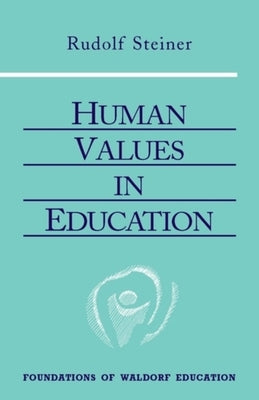
Human Values in Education: (Cw 310) Volume 20
Human Values in Education: (Cw 310) Volume 20
Couldn't load pickup availability
10 lectures, Arnheim, Holland, July 17-24, 1924 (CW 310)
The underlying thesis of these lectures--volume 20 in the "Foundations of Waldorf Education" series--is that true education must be based on knowledge of the whole human being and that such knowledge cannot be attained without love. On this basis, Steiner presents his understanding of every aspect of child development-bodily, psychological, and spiritual.
At the same time, Steiner shows that, to prove worthy of their calling, teachers must begin a process of inner development. In his view, it is the human being who gives value and meaning to the world, but modern education is gradually undermining this fact. These lectures demonstrate that education can heal such a lack of meaning and restore the value of human beings for the world.
Steiner also discusses the practical, day-to-day operation of the school. He talks about styles of teaching, teacher conferences, parent-teacher meetings, and how Waldorf education is related to the anthroposophic movement.
This book, while serving as a good introduction to Steiner's ideas on education, also represents the fruits of four years experience in the Waldorf school.
Translated from Rudolf Steiner's Der pädagogische Wert der Menschenerkenntnis und der Kulturwert der Pädagogik (GA 310), Rudolf Steiner Verlag, 1989.
Author: Rudolf Steiner
Publisher: Steiner Books
Published: 03/01/2002
Pages: 224
Binding Type: Paperback
Weight: 0.68lbs
Size: 7.86h x 5.44w x 0.58d
ISBN: 9780880105446
About the Author
Bamford, Christopher: -
Christopher Bamford (1943-2022) was born in Cardiff, South Wales, and lived for a while in Hungary and then in Scotland. He studied as an undergraduate at Trinity University in Dublin and earned his master's degree at the Annenberg School for Communication, University of Pennsylvania. For nearly thirty years, he was Editor in Chief at SteinerBooks (Anthroposophic Press) and its imprints. A Fellow of the Lindisfarne Association, he lectured, taught, and wrote widely on Western spiritual and esoteric traditions. His books include a selection of his numerous introductions, Encountering Rudolf Steiner: Introductions to Essential Works (2022); Healing Madonnas: Exploring the Sequence of Madonna Images Created by Rudolf Steiner and Felix Peipers for Use in Therapy and Meditation (2017); An Endless Trace: The Passionate Pursuit of Wisdom in the West (2003); and The Voice of the Eagle: The Heart of Celtic Christianity (1990). He also translated and edited numerous books, including Homage to Pythagoras: Rediscovering Sacred Science (2001); The Noble Traveller: The Life and Writings of O. V. de L. Milosz (1984); and Celtic Christianity: Ecology and Holiness (1982). Essays by Mr. Bamford are included in The Best Spiritual Writing 2000 ("In the Presence of Death") and The Best American Spiritual Writing 2005 ("The Gift of the Call"). Christopher passed over the threshold on May 13, 2022, at his Mt. Washington, Massachusetts home.
Steiner, Rudolf: - Rudolf Steiner (b. Rudolf Joseph Lorenz Steiner, 1861-1925) was born in the small village of Kraljevec, Austro-Hungarian Empire (now in Croatia), where he grew up. As a young man, he lived in Weimar and Berlin, where he became a well-published scientific, literary, and philosophical scholar, known especially for his work with Goethe's scientific writings. Steiner termed his spiritual philosophy anthroposophy, meaning "wisdom of the human being." As an exceptionally developed seer, he based his work on direct knowledge and perception of spiritual dimensions. He initiated a modern, universal "spiritual science" that is accessible to anyone willing to exercise clear and unbiased thinking. From his spiritual investigations, Steiner provided suggestions for the renewal of numerous activities, including education (general and for special needs), agriculture, medicine, economics, architecture, science, philosophy, Christianity, and the arts. There are currently thousands of schools, clinics, farms, and initiatives in other fields that involve practical work based on the principles Steiner developed. His many published works feature his research into the spiritual nature of human beings, the evolution of the world and humanity, and methods for personal development. He wrote some thirty books and delivered more than six thousand lectures throughout much of Europe. In 1924, Steiner founded the General Anthroposophical Society, which today has branches around the world.Share