1
/
of
1
Oxford University Press, USA
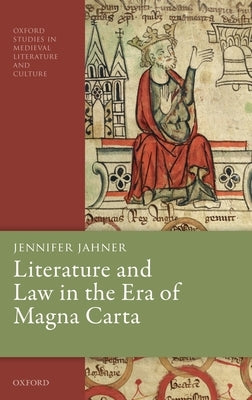
Literature and Law in the Era of Magna Carta
Literature and Law in the Era of Magna Carta
Regular price
$90.00 USD
Regular price
Sale price
$90.00 USD
Shipping calculated at checkout.
Quantity
Couldn't load pickup availability
The monograph series Oxford Studies in Medieval Literature and Culture showcases the plurilingual and multicultural quality of medieval literature and actively seeks to promote research that not only focuses on the array of subjects medievalists now pursue -- in literature, theology, and
philosophy, in social, political, jurisprudential, and intellectual history, the history of art, and the history of science -- but also that combines these subjects productively. It offers innovative studies on topics that may include, but are not limited to, manuscript and book history; languages
and literatures of the global Middle Ages; race and the post-colonial; the digital humanities, media and performance; music; medicine; the history of affect and the emotions; the literature and practices of devotion; the theory and history of gender and sexuality, ecocriticism and the environment;
theories of aesthetics; medievalism. Literature and Law in the Era of Magna Carta traces processes of literary training and experimentation across the early history of the English common law, from its beginnings in the reign of Henry II to its tumultuous consolidations under the reigns of John and Henry III. The period from the
mid-twelfth through the thirteenth centuries witnessed an outpouring of innovative legal writing in England, from Magna Carta to the scores of statute books that preserved its provisions. An era of civil war and imperial fracture, it also proved a time of intensive self-definition, as communities
both lay and ecclesiastic used law to articulate collective identities. Literature and Law in the Era of Magna Carta uncovers the role that grammatical and rhetorical training played in shaping these arguments for legal self-definition. Beginning with the life of Archbishop Thomas Becket, the book
interweaves the histories of literary pedagogy and English law, showing how foundational lessons in poetics helped generate both a language and theory of corporate autonomy. In this book, Geoffrey of Vinsauf's phenomenally popular Latin compositional handbook, the Poetria nova, finds its place
against the diplomatic backdrop of the English Interdict, while Robert Grosseteste's Anglo-French devotional poem, the Chateau d'Amour, is situated within the landscape of property law and Jewish-Christian interactions. Exploring a shared vocabulary across legal and grammatical fields, this book
argues that poetic habits of thought proved central to constructing the narratives that medieval law tells about itself and that later scholars tell about the origins of English constitutionalism.
Author: Jennifer Jahner
Publisher: Oxford University Press, USA
Published: 12/03/2019
Pages: 304
Binding Type: Hardcover
Weight: 1.20lbs
Size: 9.30h x 6.10w x 1.10d
ISBN: 9780198847724
philosophy, in social, political, jurisprudential, and intellectual history, the history of art, and the history of science -- but also that combines these subjects productively. It offers innovative studies on topics that may include, but are not limited to, manuscript and book history; languages
and literatures of the global Middle Ages; race and the post-colonial; the digital humanities, media and performance; music; medicine; the history of affect and the emotions; the literature and practices of devotion; the theory and history of gender and sexuality, ecocriticism and the environment;
theories of aesthetics; medievalism. Literature and Law in the Era of Magna Carta traces processes of literary training and experimentation across the early history of the English common law, from its beginnings in the reign of Henry II to its tumultuous consolidations under the reigns of John and Henry III. The period from the
mid-twelfth through the thirteenth centuries witnessed an outpouring of innovative legal writing in England, from Magna Carta to the scores of statute books that preserved its provisions. An era of civil war and imperial fracture, it also proved a time of intensive self-definition, as communities
both lay and ecclesiastic used law to articulate collective identities. Literature and Law in the Era of Magna Carta uncovers the role that grammatical and rhetorical training played in shaping these arguments for legal self-definition. Beginning with the life of Archbishop Thomas Becket, the book
interweaves the histories of literary pedagogy and English law, showing how foundational lessons in poetics helped generate both a language and theory of corporate autonomy. In this book, Geoffrey of Vinsauf's phenomenally popular Latin compositional handbook, the Poetria nova, finds its place
against the diplomatic backdrop of the English Interdict, while Robert Grosseteste's Anglo-French devotional poem, the Chateau d'Amour, is situated within the landscape of property law and Jewish-Christian interactions. Exploring a shared vocabulary across legal and grammatical fields, this book
argues that poetic habits of thought proved central to constructing the narratives that medieval law tells about itself and that later scholars tell about the origins of English constitutionalism.
Author: Jennifer Jahner
Publisher: Oxford University Press, USA
Published: 12/03/2019
Pages: 304
Binding Type: Hardcover
Weight: 1.20lbs
Size: 9.30h x 6.10w x 1.10d
ISBN: 9780198847724
About the Author
Jennifer Jahner, Assistant Professor of English, Caltech
Share