Oxford University Press, USA
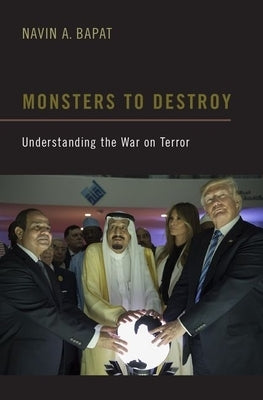
Monsters to Destroy: Understanding the War on Terror
Monsters to Destroy: Understanding the War on Terror
Couldn't load pickup availability
loss of influence over these states has accelerated the decline of U.S. economic and military power, locking it into a permanent war for its own economic security.
Author: Navin A. Bapat
Publisher: Oxford University Press, USA
Published: 12/06/2019
Pages: 232
Binding Type: Paperback
Weight: 0.75lbs
Size: 9.10h x 6.10w x 0.60d
ISBN: 9780190061463
About the Author
Navin A. Bapat is Professor of Political Science and the Chair of the Curriculum of Peace, War, and Defense at the University of North Carolina - Chapel Hill. His research utilizes mathematical modeling to develop theoretical explanations of political conflicts, including issues related to terrorism, insurgency, and economic sanctions. He has received two grants from the National Science Foundation, one to examine the effectiveness of economic sanctions, and another to examine the growth of insurgent movements from small cells to large-scale rebellions. He has published in the American Journal of Political Science, the Journal of Politics, International Organization, International Studies Quarterly, the British Journal of Political Science, Public Choice, the Journal of Peace Research, International Interactions, and Conflict Management and Peace Science.
Share