1
/
of
1
Cambridge University Press
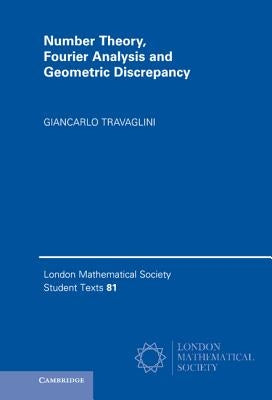
Number Theory, Fourier Analysis and Geometric Discrepancy
Number Theory, Fourier Analysis and Geometric Discrepancy
Regular price
$227.74 USD
Regular price
Sale price
$227.74 USD
Shipping calculated at checkout.
Quantity
Couldn't load pickup availability
The study of geometric discrepancy, which provides a framework for quantifying the quality of a distribution of a finite set of points, has experienced significant growth in recent decades. This book provides a self-contained course in number theory, Fourier analysis and geometric discrepancy theory, and the relations between them, at the advanced undergraduate or beginning graduate level. It starts as a traditional course in elementary number theory, and introduces the reader to subsequent material on uniform distribution of infinite sequences, and discrepancy of finite sequences. Both modern and classical aspects of the theory are discussed, such as Weyl's criterion, Benford's law, the Koksma-Hlawka inequality, lattice point problems, and irregularities of distribution for convex bodies. Fourier analysis also features prominently, for which the theory is developed in parallel, including topics such as convergence of Fourier series, one-sided trigonometric approximation, the Poisson summation formula, exponential sums, decay of Fourier transforms, and Bessel functions.
Author: Giancarlo Travaglini
Publisher: Cambridge University Press
Published: 06/12/2014
Pages: 252
Binding Type: Hardcover
Weight: 1.05lbs
Size: 9.00h x 5.80w x 0.70d
ISBN: 9781107044036
Author: Giancarlo Travaglini
Publisher: Cambridge University Press
Published: 06/12/2014
Pages: 252
Binding Type: Hardcover
Weight: 1.05lbs
Size: 9.00h x 5.80w x 0.70d
ISBN: 9781107044036
About the Author
Travaglini, Giancarlo: - Giancarlo Travaglini is Professor of Mathematics at the University of Milano-Bicocca. He is the author of numerous research papers and several books in the areas of abstract harmonic analysis, Fourier analysis and discrepancy theory. He is a member of the Unione Matematica Italiana and the American Mathematical Society. His current mathematical interests include Fourier analysis, discrepancy theory, radon transforms and didactics of mathematics.
Share