1
/
of
1
Oxford University Press, USA
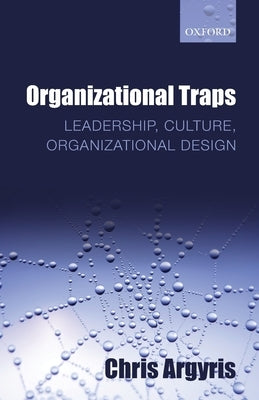
Organizational Traps: Leadership, Culture, Organizational Design
Organizational Traps: Leadership, Culture, Organizational Design
Regular price
$42.95 USD
Regular price
Sale price
$42.95 USD
Shipping calculated at checkout.
Quantity
Couldn't load pickup availability
Anyone who has spent time in an organization knows that dysfunctional behavior abounds. Conflict is frequently avoided or pushed underground rather than dealt with openly. At the same time, the same arguments often burst out again and again, almost verbatim. Turf battles continue for extended
periods without resolution. People nod their heads in agreement in meetings, and then rush out of the room to voice complaints to sympathetic ears in private. Worst of all, when people are asked if things will ever change, they throw up their hands in despair. They feel like victims trapped in an
asylum. And people often are trapped. But they are not trapped by some oppressive regime or organizational structure that has been imposed on them. They are not victims. In fact, people themselves are responsible for making the status quo so resistant to change. We are trapped by our own behavior. Researchers and practitioners have often reflected on these things, but there is a puzzle. On the one hand, there is substantial agreement that these traps are counterproductive to effective performance. On the other hand, there is almost no focus on how organizational traps can be prevented or
reduced. This book argues that whatever theory is used to describe and understand such organizational traps should be used to design and implement interventions that reduce and prevent them. Argyris is one of the world's leading management scholars whose work has consistently shed light on organizational
problems. This book is essential reading for MBAs, managers, and consultants.
Author: Chris Argyris
Publisher: Oxford University Press, USA
Published: 03/02/2012
Pages: 224
Binding Type: Paperback
Weight: 0.60lbs
Size: 8.50h x 5.40w x 0.40d
ISBN: 9780199639649
periods without resolution. People nod their heads in agreement in meetings, and then rush out of the room to voice complaints to sympathetic ears in private. Worst of all, when people are asked if things will ever change, they throw up their hands in despair. They feel like victims trapped in an
asylum. And people often are trapped. But they are not trapped by some oppressive regime or organizational structure that has been imposed on them. They are not victims. In fact, people themselves are responsible for making the status quo so resistant to change. We are trapped by our own behavior. Researchers and practitioners have often reflected on these things, but there is a puzzle. On the one hand, there is substantial agreement that these traps are counterproductive to effective performance. On the other hand, there is almost no focus on how organizational traps can be prevented or
reduced. This book argues that whatever theory is used to describe and understand such organizational traps should be used to design and implement interventions that reduce and prevent them. Argyris is one of the world's leading management scholars whose work has consistently shed light on organizational
problems. This book is essential reading for MBAs, managers, and consultants.
Author: Chris Argyris
Publisher: Oxford University Press, USA
Published: 03/02/2012
Pages: 224
Binding Type: Paperback
Weight: 0.60lbs
Size: 8.50h x 5.40w x 0.40d
ISBN: 9780199639649
About the Author
Chris Argyris is the James Bryant Conant Professor of Education and Organizational Behavior Emeritus at Harvard University. He has consulted to numerous private and governmental organizations. He has received many awards including thirteen honorary degrees and Lifetime Contribution Awards from the Academy of Management, American Psychological Association, and American Society of Training Directors. His most recent books are, Flawed Advice and the Management Trap (OUP, 1999), and Reasons and Rationalizations (OUP, 2004). A chair professorship was established in his name in 1994 at Yale University. He is a Director Emeritus of Monitor Group.
Share