1
/
of
1
Fordham University Press
Post-Cartesian Meditations
Post-Cartesian Meditations
Regular price
$62.74 USD
Regular price
Sale price
$62.74 USD
Shipping calculated at checkout.
Quantity
Couldn't load pickup availability
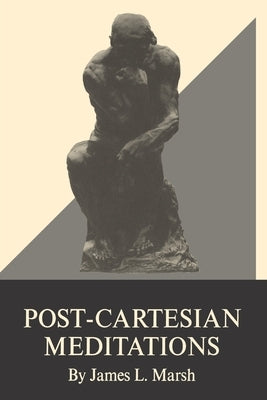
Although this book derives its inspiration and model from Descartes' Meditations and Husserl's Cartesian Meditations, it attempts to overcome Cartesianism conceived as individualistic, reflective, apodictic, presuppositionless self-recovery. Instead, contends Professor Marsh, the isolated, individualistic, brougeois ego gives way to the social, communal, post-bourgeois self: wordly, linguistic, historical, practical, and critical. The book attempts to overcome Cartesianism both in content and in form. In content, Marsh argues, the social self replaces the isolated ego; this he attempts to establish through a series of chapters progressively expanding their scope and social context. Beginning with an emphasis on individual perception, thought, and freedom, and moving through reflections on knowledge of the other, practical engagments with the other, and hermeneutics, he concludes with critiques of the psychological and social unconscious. The result is not a rejection of individual perception, reflection, and freedom, but their sublation within community, tradition, and history. For Marsh the authentic individual is the social individual, the individual-in-community. This book not only inscribes a progressively expanding circle, but also moves in a circle. It begins with a reflection on the contemporary experience of alientation and history of philosophy, ascends in the next several chapters to considering the perceptual, cognitive, free, social self, and then descends in the last chapter to further discussion of this historical starting points in this practical and philosophical aspects. Dialectical phenomenology as method bends back on itself to reflect in a manner both critical and redemptive on its own starting point and genesis. Post-Cartesian Meditations obviously situates itself withing the modernism/post-modernism debate being carried on by Ricoeur and Derrida, Habermas and Foucault, Searle and Rorty, Bernstein and Caputo. Like post-modernism, the book is critical of naive Cartesian presence, the excesses of technological rationality, the pathology of modernity, the irrationality of bourgeois society. Unlike post-modernism, however, the book argues for a socially mediated self, the legitimacy of technology in contrast to technocracy, the critical redemption of modernity, a dialectical rather than a rejectionistic overcoming of capitalism. Rich in insight, suggestion, and argumentation, this book has much to offer students and instructors of philosophy generally, but will be particularly useful to those interested in phenomenological developments, or a Marxist critique of capitalism as a way of life influencing modern philosophical thought.
Author: James L. Marsh
Publisher: Fordham University Press
Published: 01/01/1988
Pages: 279
Binding Type: Paperback
Weight: 0.90lbs
Size: 8.90h x 5.90w x 0.80d
ISBN: 9780823212170
Author: James L. Marsh
Publisher: Fordham University Press
Published: 01/01/1988
Pages: 279
Binding Type: Paperback
Weight: 0.90lbs
Size: 8.90h x 5.90w x 0.80d
ISBN: 9780823212170
About the Author
James L. Marsh is Professor Emeritus of Philosophy at Fordham University. He has published widely in such philosophical journals as International Philosophical Quarterly, New German Critique, and International Journal for Philosophy of Religion.
Share