1
/
of
1
Oxford University Press, USA
Proportionality Balancing and Constitutional Governance: A Comparative and Global Approach
Proportionality Balancing and Constitutional Governance: A Comparative and Global Approach
Regular price
$42.95 USD
Regular price
Sale price
$42.95 USD
Shipping calculated at checkout.
Quantity
Couldn't load pickup availability
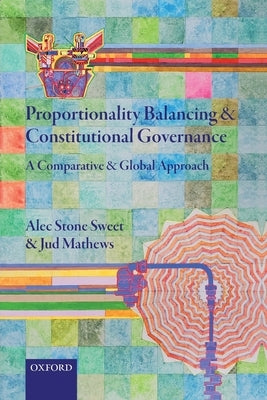
In this book, Alec Stone Sweet and Jud Mathews focus on the law and politics of rights protection in democracies, and in human rights regimes in Europe, the Americas, and Africa. After introducing the basic features of modern constitutions, with their emphasis on rights and judicial review,
the authors present a theory of proportionality that explains why constitutional judges embraced it. Proportionality analysis is a highly intrusive mode of judicial supervision: it permits state officials to limit rights, but only when necessary to achieve a sufficiently important public interest.
Since the 1950s, virtually every powerful domestic and international court has adopted proportionality analysis as the central method for protecting rights. In doing so, judges positioned themselves to review all important legislative and administrative decisions, and to invalidate them as
unconstitutional when such policies fail the proportionality test. The result has been a massive - and global - transformation of law and politics. The book explicates the concepts of 'trusteeship', the 'system of constitutional justice', the 'effectiveness' of rights adjudication, and the 'zone of
proportionality'. A wide range of case studies analyse: how proportionality has spread, and variation in how it is deployed; the extent to which the U.S. Supreme Court has evolved and resisted similar doctrines; the role of proportionality in building ongoing 'constitutional dialogues' with the
other branches of government; and the importance of the principle to the courts of regional human rights regimes. While there is variance in the intensity of proportionality-based dialogues, such interactions are today at the very heart of governance in the modern constitutional state and beyond.
Author: Alec Stone Sweet, Jud Mathews
Publisher: Oxford University Press, USA
Published: 07/15/2019
Pages: 256
Binding Type: Paperback
Weight: 0.90lbs
Size: 9.20h x 6.10w x 0.70d
ISBN: 9780198841401
the authors present a theory of proportionality that explains why constitutional judges embraced it. Proportionality analysis is a highly intrusive mode of judicial supervision: it permits state officials to limit rights, but only when necessary to achieve a sufficiently important public interest.
Since the 1950s, virtually every powerful domestic and international court has adopted proportionality analysis as the central method for protecting rights. In doing so, judges positioned themselves to review all important legislative and administrative decisions, and to invalidate them as
unconstitutional when such policies fail the proportionality test. The result has been a massive - and global - transformation of law and politics. The book explicates the concepts of 'trusteeship', the 'system of constitutional justice', the 'effectiveness' of rights adjudication, and the 'zone of
proportionality'. A wide range of case studies analyse: how proportionality has spread, and variation in how it is deployed; the extent to which the U.S. Supreme Court has evolved and resisted similar doctrines; the role of proportionality in building ongoing 'constitutional dialogues' with the
other branches of government; and the importance of the principle to the courts of regional human rights regimes. While there is variance in the intensity of proportionality-based dialogues, such interactions are today at the very heart of governance in the modern constitutional state and beyond.
Author: Alec Stone Sweet, Jud Mathews
Publisher: Oxford University Press, USA
Published: 07/15/2019
Pages: 256
Binding Type: Paperback
Weight: 0.90lbs
Size: 9.20h x 6.10w x 0.70d
ISBN: 9780198841401
About the Author
Alec Stone Sweet, Saw Swee Hock Centennial Professor of Law, National University of Singapore; Senior Research Fellow, the Yale Law School, Jud Mathews, Associate Professor of Law at Penn State Law and a Faculty Affiliate of Penn State's School of International Affairs
Share