Oxford University Press, USA
Regulating the Visible Hand?: The Institutional Implications of Chinese State Capitalism
Regulating the Visible Hand?: The Institutional Implications of Chinese State Capitalism
Couldn't load pickup availability
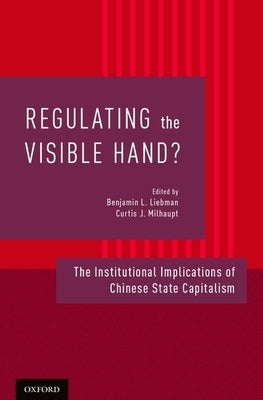
Institutional Implications of Chinese State Capitalism examines the domestic and global consequences of Chinese state capitalism, focusing on the impact of state-owned enterprises on regulation and policy, while placing China's variety of state capitalism in comparative perspective. It first
examines the domestic governance of Chinese state capitalism, looking at institutional design and regulatory policy in areas ranging from the environment and antitrust to corporate law and taxation. It then analyses the global consequences for the regulation of trade, investment and finance.
Contributors address such questions as: What are the implications of state capitalism for China's domestic institutional trajectory? What are the global implications of Chinese state capitalism? What can be learned from a comparative analysis of state capitalism?
Author: Benjamin L. Liebman
Publisher: Oxford University Press, USA
Published: 11/16/2015
Pages: 480
Binding Type: Hardcover
Weight: 1.80lbs
Size: 9.30h x 6.10w x 1.20d
ISBN: 9780190250256
About the Author
Benjamin L. Liebman is the Robert L. Lieff Professor of Law and Director of the Center for Chinese Legal Studies at Columbia University Law School. His current research focuses on Chinese tort law, on Chinese criminal procedure, on the impact of popular opinion and populism on the Chinese legal
system, and on the evolution of China's courts and legal profession. Professor Liebman is recognized as one of the leading scholars of Chinese law, and consulted with both the U.S. and Chinese governments on legal developments in China. He previously served as a law clerk to Justice David Souter and
to Judge Sandra Lynch of the First Circuit. He is a graduate of Yale, Oxford, and Harvard Law School.
University's Weatherhead East Asian Institute, the American Law Institute, and the European Corporate Governance Institute. His research, which focuses on comparative corporate governance, the legal systems of East Asia, state capitalism, and the relationship between legal institutions and economic
development, has been featured in The Economist, the Financial Times and The Wall Street Journal, and has been widely translated.
Share