1
/
of
1
Palgrave MacMillan
Rethinking Commonsense Psychology: A Critique of Folk Psychology, Theory of Mind and Simulation
Rethinking Commonsense Psychology: A Critique of Folk Psychology, Theory of Mind and Simulation
Regular price
$88.99 USD
Regular price
Sale price
$88.99 USD
Shipping calculated at checkout.
Quantity
Couldn't load pickup availability
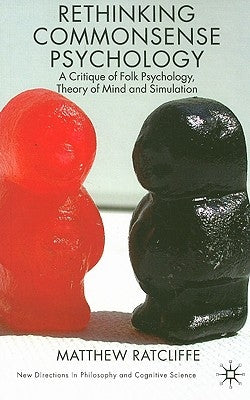
What is it to understand another person? A popular view in philosophy of mind, cognitive science and various other disciplines is that interpersonal understanding is a matter of employing a 'commonsense' or 'folk' psychology, consisting primarily of an ability to attribute internal propositional attitudes on the basis of behavioural observations. The emphasis of recent debates has been on which mechanisms enable us to do this, how they arise during development and how they might have evolved, rather than on whether we actually do it at all. Ratcliffe disputes the shared premise on which these debates rest. He argues that 'folk psychology', as generally described, is a theoretically motivated, simplistic and misleading abstraction from social life, which is wrongly asserted to be 'commonsense' or 'what the folk think'. Drawing on phenomenology, neuroscience and development psychology, he offers an alternative account of interpersonal understanding. This account emphasizes a distinctive kind of bodily relatedness between people and the extent to which interpersonal interactions are regulated by shared social environments.
Author: M. Ratcliffe
Publisher: Palgrave MacMillan
Published: 11/01/2008
Pages: 284
Binding Type: Paperback
Weight: 0.80lbs
Size: 8.40h x 5.40w x 0.70d
ISBN: 9780230221208
Author: M. Ratcliffe
Publisher: Palgrave MacMillan
Published: 11/01/2008
Pages: 284
Binding Type: Paperback
Weight: 0.80lbs
Size: 8.40h x 5.40w x 0.70d
ISBN: 9780230221208
About the Author
MATTHEW RATCLIFFE is Reader in Philosophy at Durham University, UK. He is the author of Feelings of Being: Phenomenology, Psychiatry and the Sense of Reality (2008) and co-editor of Folk Psychology Re-assessed (2007).
Share