1
/
of
1
Oxford University Press, USA
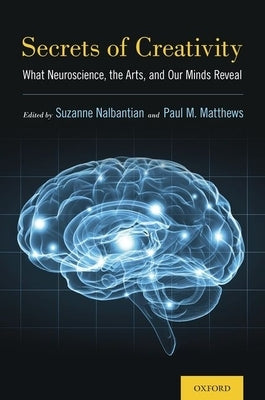
Secrets of Creativity: What Neuroscience, the Arts, and Our Minds Reveal
Secrets of Creativity: What Neuroscience, the Arts, and Our Minds Reveal
Regular price
$95.00 USD
Regular price
Sale price
$95.00 USD
Shipping calculated at checkout.
Quantity
Couldn't load pickup availability
Secrets of Creativity: What Neuroscience, the Arts, and Our Minds Reveal draws on insights from leading neuroscientists and scholars in the humanities and the arts to probe creativity in its many contexts, in the everyday mind, the exceptional mind, the scientific mind, the artistic mind, and
the pathological mind. Components of creativity are specified with respect to types of memory, forms of intelligence, modes of experience, and kinds of emotion. Authors in this volume take on the challenge of showing how creativity can be characterized behaviorally, cognitively, and
neurophysiologically. The complementary perspectives of the authors add to the richness of these findings. Neuroscientists describe the functioning of the brain and its circuitry in creative acts of scientific discovery or aesthetic production. Humanists from the fields of literature, art, and music
give analyses of creativity in major literary works, musical compositions, and works of visual art.
Author: Suzanne Nalbantian
Publisher: Oxford University Press, USA
Published: 09/23/2019
Pages: 456
Binding Type: Hardcover
Weight: 1.75lbs
Size: 9.40h x 6.30w x 1.40d
ISBN: 9780190462321
Review Citation(s):
Choice 06/01/2020
volumes. Her book Memory in Literature: From Rousseau to Neuroscience (Palgrave 2003) forged new pathways linking literary depictions of memory to neuroscience. She is the principal editor of The Memory Process: Neuroscientific and Humanistic Perspectives (MIT Press 2011), which features original
essays by both humanists and brain scientists. She has lectured widely throughout the U.S. and Europe on the topic of memory at such institutions as Harvard, Yale, Stanford, College de France (Paris), the European Science Foundation, Max-Planck (Tubingen), and the Pasteur Institute (Paris). Paul M. Matthews is the Edmund J. and Lily Safra Chair of Translational Neuroscience and Therapeutics, Head of the Division of Brain Sciences in the Department of Medicine of Imperial College, London, and Associate Director of the UK Dementia Research Institute. He is Fellow by Special Election in
St. Edmund Hall, Oxford and holds Visiting Professorships at McGill University, Nanyang Technological University and the University of Edinburgh. Professor Matthews was awarded an OBE in 2008 for services to neuroscience and was elected to the Academy of Medical Sciences in 2014. He is the coauthor
of over 380 scientific papers. He is also co-author (with Jeffrey McQuain) of the book The Bard on the Brain: Understanding the Mind through the Art of Shakespeare and the Science of Brain Imaging and co-editor (with Suzanne Nalbantian and James McClelland) of The Memory Process: Neuroscientific and
Humanistic Perspectives (MIT Press 2011).
the pathological mind. Components of creativity are specified with respect to types of memory, forms of intelligence, modes of experience, and kinds of emotion. Authors in this volume take on the challenge of showing how creativity can be characterized behaviorally, cognitively, and
neurophysiologically. The complementary perspectives of the authors add to the richness of these findings. Neuroscientists describe the functioning of the brain and its circuitry in creative acts of scientific discovery or aesthetic production. Humanists from the fields of literature, art, and music
give analyses of creativity in major literary works, musical compositions, and works of visual art.
Author: Suzanne Nalbantian
Publisher: Oxford University Press, USA
Published: 09/23/2019
Pages: 456
Binding Type: Hardcover
Weight: 1.75lbs
Size: 9.40h x 6.30w x 1.40d
ISBN: 9780190462321
Review Citation(s):
Choice 06/01/2020
About the Author
Suzanne Nalbantian, Professor of English and Comparative Literature, Long Island University, Paul M. Matthews, Edmund J. and Lily Safra Chair of Translational Neuroscience and Therapeutics, Imperial College London
volumes. Her book Memory in Literature: From Rousseau to Neuroscience (Palgrave 2003) forged new pathways linking literary depictions of memory to neuroscience. She is the principal editor of The Memory Process: Neuroscientific and Humanistic Perspectives (MIT Press 2011), which features original
essays by both humanists and brain scientists. She has lectured widely throughout the U.S. and Europe on the topic of memory at such institutions as Harvard, Yale, Stanford, College de France (Paris), the European Science Foundation, Max-Planck (Tubingen), and the Pasteur Institute (Paris). Paul M. Matthews is the Edmund J. and Lily Safra Chair of Translational Neuroscience and Therapeutics, Head of the Division of Brain Sciences in the Department of Medicine of Imperial College, London, and Associate Director of the UK Dementia Research Institute. He is Fellow by Special Election in
St. Edmund Hall, Oxford and holds Visiting Professorships at McGill University, Nanyang Technological University and the University of Edinburgh. Professor Matthews was awarded an OBE in 2008 for services to neuroscience and was elected to the Academy of Medical Sciences in 2014. He is the coauthor
of over 380 scientific papers. He is also co-author (with Jeffrey McQuain) of the book The Bard on the Brain: Understanding the Mind through the Art of Shakespeare and the Science of Brain Imaging and co-editor (with Suzanne Nalbantian and James McClelland) of The Memory Process: Neuroscientific and
Humanistic Perspectives (MIT Press 2011).
Share