1
/
of
1
Routledge
Sir James Dewar, 1842-1923: A Ruthless Chemist
Sir James Dewar, 1842-1923: A Ruthless Chemist
Regular price
$382.08 USD
Regular price
Sale price
$382.08 USD
Shipping calculated at checkout.
Quantity
Couldn't load pickup availability
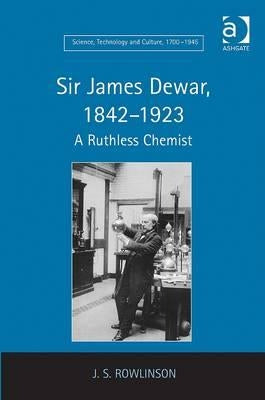
Sir James Dewar was a major figure in British chemistry for around 40 years. He held the posts of Jacksonian Professor of Natural Philosophy at Cambridge (1875-1923) and Fullerian Professor of Chemistry at the Royal Institution (1877-1923) and is remembered principally for his efforts to liquefy hydrogen successfully in the field that would come to be known as cryogenics. His experiments in this field led him to develop the vacuum flask, now more commonly known as the thermos, and in 1898 he was the first person to successfully liquefy hydrogen. A man of many interests, he was also, with Frederick Abel, the inventor of explosive cordite, an achievement that involved him in a major legal battle with Alfred Nobel. Indeed, Dewar's career saw him involved in a number of public quarrels with fellow scientists; he was a fierce and sometimes unscrupulous defender of his rights and his claims to priority in a way that throws much light on the scientific spirit and practice of his day. This, the first scholarly biography of Dewar, seeks to resurrect and reinterpret a man who was a giant of his time, but is now sadly overlooked. In so doing, the book will shed much new light on the scientific culture of the late-nineteenth and early-twentieth centuries and the development of the field of chemistry in Britain.
Author: J. S. Rowlinson
Publisher: Routledge
Published: 08/28/2012
Pages: 254
Binding Type: Hardcover
Weight: 1.18lbs
Size: 9.21h x 6.14w x 0.63d
ISBN: 9781409406136
Review Citation(s):
Choice 04/01/2013
Author: J. S. Rowlinson
Publisher: Routledge
Published: 08/28/2012
Pages: 254
Binding Type: Hardcover
Weight: 1.18lbs
Size: 9.21h x 6.14w x 0.63d
ISBN: 9781409406136
Review Citation(s):
Choice 04/01/2013
About the Author
Professor Sir John Rowlinson was Dr Lee's Professor of Chemistry at the University of Oxford and is a Fellow of Exeter College. He is a Fellow of the Royal Society and of the Royal Academy of Engineering. He received the Edelstein Award from the American Chemical Society in 2008 for his contributions to the history of chemistry.
Share