1
/
of
1
Cambridge University Press
The Great Divergence Reconsidered: Europe, India, and the Rise to Global Economic Power
The Great Divergence Reconsidered: Europe, India, and the Rise to Global Economic Power
Regular price
$33.94 USD
Regular price
Sale price
$33.94 USD
Shipping calculated at checkout.
Quantity
Couldn't load pickup availability
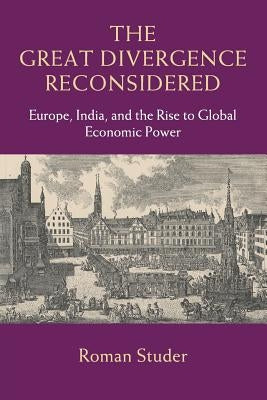
In stark contrast to popular narratives, The Great Divergence Reconsidered shows that Europe's rise to an undisputed world economic leader was not the effect of the Industrial Revolution, and cannot be explained by coal or colonial exploitation. Using a wealth of new historical evidence stretching from the seventeenth to the twentieth century, Roman Studer shows that this 'Great Divergence' must be shifted back to the seventeenth century, if not earlier. Europe was characterized by a more powerful transportation system, bigger trade flows, larger and better integrated markets, higher productivity levels, and superior living standards even before the Industrial Revolution brought about far-reaching structural changes and made Europe's supremacy even more pronounced. While the comparison with Europe draws significantly on India, the central conclusions seem to hold for Asia - and indeed the rest of the world - more generally. An interplay of various factors best explains Europe's early and gradual rise, including better institutions, favorable geographical features, increasing political stability, and increasingly rapid advances in science and technology.
Author: Roman Studer
Publisher: Cambridge University Press
Published: 06/15/2017
Pages: 243
Binding Type: Paperback
Weight: 0.73lbs
Size: 9.00h x 6.00w x 0.51d
ISBN: 9781107679979
Author: Roman Studer
Publisher: Cambridge University Press
Published: 06/15/2017
Pages: 243
Binding Type: Paperback
Weight: 0.73lbs
Size: 9.00h x 6.00w x 0.51d
ISBN: 9781107679979
About the Author
Studer, Roman: - Roman Studer has worked both in academia and in the private sector, and he is currently the chief operating officer of the UBS International Center of Economics in Society at Universität Zürich. He was a postdoctoral prize research fellow at the University of Oxford and then a lecturer at the London School of Economics and Political Science. He was awarded the Alexander Gerschenkron Prize by the Economic History Association for the best dissertation in international economic history.
Share