Duke University Press
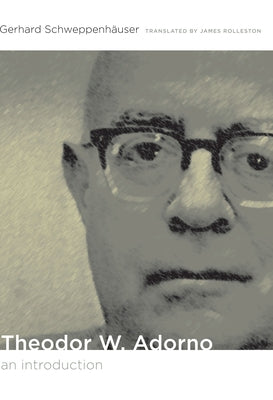
Theodor W. Adorno: An Introduction
Theodor W. Adorno: An Introduction
Couldn't load pickup availability
After providing a brief overview of Adorno's life, Schweppenhäuser turns to the theorist's core philosophical concepts, including post-Kantian critique, determinate negation, and the primacy of the object, as well as his view of the Enlightenment as a code for world domination, his diagnosis of modern mass culture as a program of social control, and his understanding of modernist aesthetics as a challenge to conceive an alternative politics. Along the way, Schweppenhäuser illuminates the works widely considered Adorno's most important achievements: Minima Moralia, Dialectic of Enlightenment (co-authored with Horkheimer), and Negative Dialectics. Adorno wrote much of the first two of these during his years in California (1938-49), where he lived near Arnold Schoenberg and Thomas Mann, whom he assisted with the musical aesthetics at the center of Mann's novel Doctor Faustus.
Author: Gerhard Schweppenhäuser
Publisher: Duke University Press
Published: 04/06/2009
Pages: 200
Binding Type: Paperback
Weight: 0.70lbs
Size: 8.40h x 5.90w x 0.70d
ISBN: 9780822344711
Review Citation(s):
Choice 10/01/2009
About the Author
Gerhard Schweppenhäuser is Professor of Design, Communication, and Media Theory at the University of Würzburg in Germany. He has written many books building on the sociocultural, analytical mission of the Frankfurt School, including two focused on Adorno. James L. Rolleston is Professor Emeritus of Germanic Languages and Literatures at Duke University. He has written books on Kafka, Rilke, and modern German poetry. His translation of Bernd Witte's Walter Benjamin: An Intellectual Biography won the German Literary Prize of the American Translators Association. His and Kai Evers's translation of Peter Weiss's last play, The New Trial, is also published by Duke University Press.
Share