Rockport Publishers
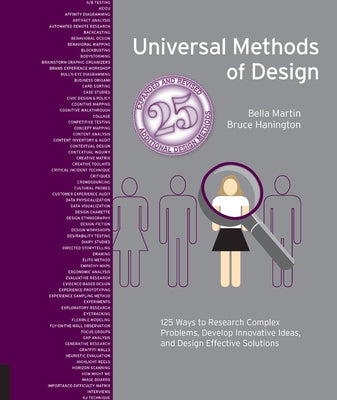
Universal Methods of Design, Expanded and Revised: 125 Ways to Research Complex Problems, Develop Innovative Ideas, and Design Effective Solutions
Universal Methods of Design, Expanded and Revised: 125 Ways to Research Complex Problems, Develop Innovative Ideas, and Design Effective Solutions
Couldn't load pickup availability
- Dismantles the myth that user research methods are complicated, expensive, and time-consuming
- Creates a shared meaning for cross-disciplinary teams
- Illustrates methods with compelling visualizations and case studies
- Characterizes each method at a glance
- Indicates when methods are best employed to help prioritize appropriate design research strategies
Author: Bruce Hanington, Bella Martin
Publisher: Rockport Publishers
Published: 12/03/2019
Pages: 264
Binding Type: Paperback
Weight: 2.20lbs
Size: 10.90h x 8.40w x 0.80d
ISBN: 9781631597480
About the Author
Bruce Hanington is a professor and head of the School of Design at Carnegie Mellon University in Pittsburgh, Pennsylvania. Prior to this, he was director of graduate studies, and program chair of industrial design. Bruce has dedicated his teaching and research to methods and practices for human centered design, with an emphasis on design ethnography, participatory design, and the meaning of form in context. In addition to working with industry partners through collaborative projects and executive education, his work has been published in Design Issues, The Design Journal, and Interactions, with chapters in Affective Sciences in Human Factors and Human-Computer Interaction and The Routledge Handbook of Sustainable Design.
Bella Martin is a Lead User Experience Researcher in Atlanta, Georgia. After contributing to award-winning design projects for Microsoft Research, the US Postal Service, GlaxoSmithKline, and Allstate Financial, she now invests much of her time working with organizations who are new to the methods of user-centered research, but eager to give their users a voice in the design process. Bella holds a Master of Design from Carnegie Mellon University, where she first began her ongoing work in visualizing user-centered research methods.
Share