1
/
of
1
Oxford University Press, USA
Vicarious Narratives: A Literary History of Sympathy
Vicarious Narratives: A Literary History of Sympathy
Regular price
$166.70 USD
Regular price
Sale price
$166.70 USD
Shipping calculated at checkout.
Quantity
Couldn't load pickup availability
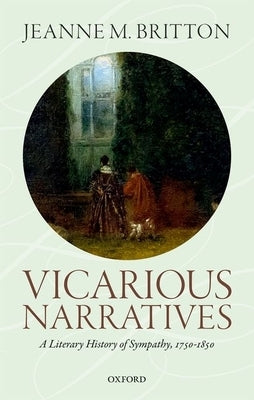
Adam Smith's Theory of Moral Sentiments (1759) defines sympathy as a series of shifts in perspective by which one sees from a different point of view. British and French novels published over the following century redefine sympathy through narrative form--shifting perspectives or 'stories
within stories' in which one character adopts the voice and perspective of another. Fiction follows Smith's emphasis on sympathy's shifting perspectives, but this formal echo coincides with a challenge. For Smith and other Enlightenment philosophers, the experience of sympathy relies on human
resemblance. In novels, by contrast, characters who are separated by nationality, race, or species experience a version of sympathy that struggles to accommodate such differences. Encounters between these characters produce shifts in perspective or framed tales as one character sympathizes with
another and begins to tell her story, echoing Smith's definition of sympathy in their form while challenging Enlightenment philosophy's insistence on human resemblance. Works of sentimental and gothic fiction published between 1750 and 1850 generate a novelistic version of sympathy by manipulating traditional narrative forms (epistolary fiction, embedded tales) and new publication practices (the anthology, the novelistic extract). Second-hand stories transform the
vocal mobility, emotional immediacy, and multiple perspectives associated with the declining genre of epistolary fiction into the narrative levels and shifting speakers of nineteenth-century frame tales. Vicarious Narratives argues that fiction redefines sympathy as the struggle to overcome
difference through the active engagement with narrative--by listening to, re-telling, and transcribing the stories of others.
Author: Jeanne M. Britton
Publisher: Oxford University Press, USA
Published: 11/19/2019
Pages: 256
Binding Type: Hardcover
Weight: 0.85lbs
Size: 8.60h x 5.40w x 0.90d
ISBN: 9780198846697
within stories' in which one character adopts the voice and perspective of another. Fiction follows Smith's emphasis on sympathy's shifting perspectives, but this formal echo coincides with a challenge. For Smith and other Enlightenment philosophers, the experience of sympathy relies on human
resemblance. In novels, by contrast, characters who are separated by nationality, race, or species experience a version of sympathy that struggles to accommodate such differences. Encounters between these characters produce shifts in perspective or framed tales as one character sympathizes with
another and begins to tell her story, echoing Smith's definition of sympathy in their form while challenging Enlightenment philosophy's insistence on human resemblance. Works of sentimental and gothic fiction published between 1750 and 1850 generate a novelistic version of sympathy by manipulating traditional narrative forms (epistolary fiction, embedded tales) and new publication practices (the anthology, the novelistic extract). Second-hand stories transform the
vocal mobility, emotional immediacy, and multiple perspectives associated with the declining genre of epistolary fiction into the narrative levels and shifting speakers of nineteenth-century frame tales. Vicarious Narratives argues that fiction redefines sympathy as the struggle to overcome
difference through the active engagement with narrative--by listening to, re-telling, and transcribing the stories of others.
Author: Jeanne M. Britton
Publisher: Oxford University Press, USA
Published: 11/19/2019
Pages: 256
Binding Type: Hardcover
Weight: 0.85lbs
Size: 8.60h x 5.40w x 0.90d
ISBN: 9780198846697
About the Author
Jeanne M. Britton, Curator, Irvin Department of Rare Books and Special Collections, University of South Carolina
This title is not returnable
Share